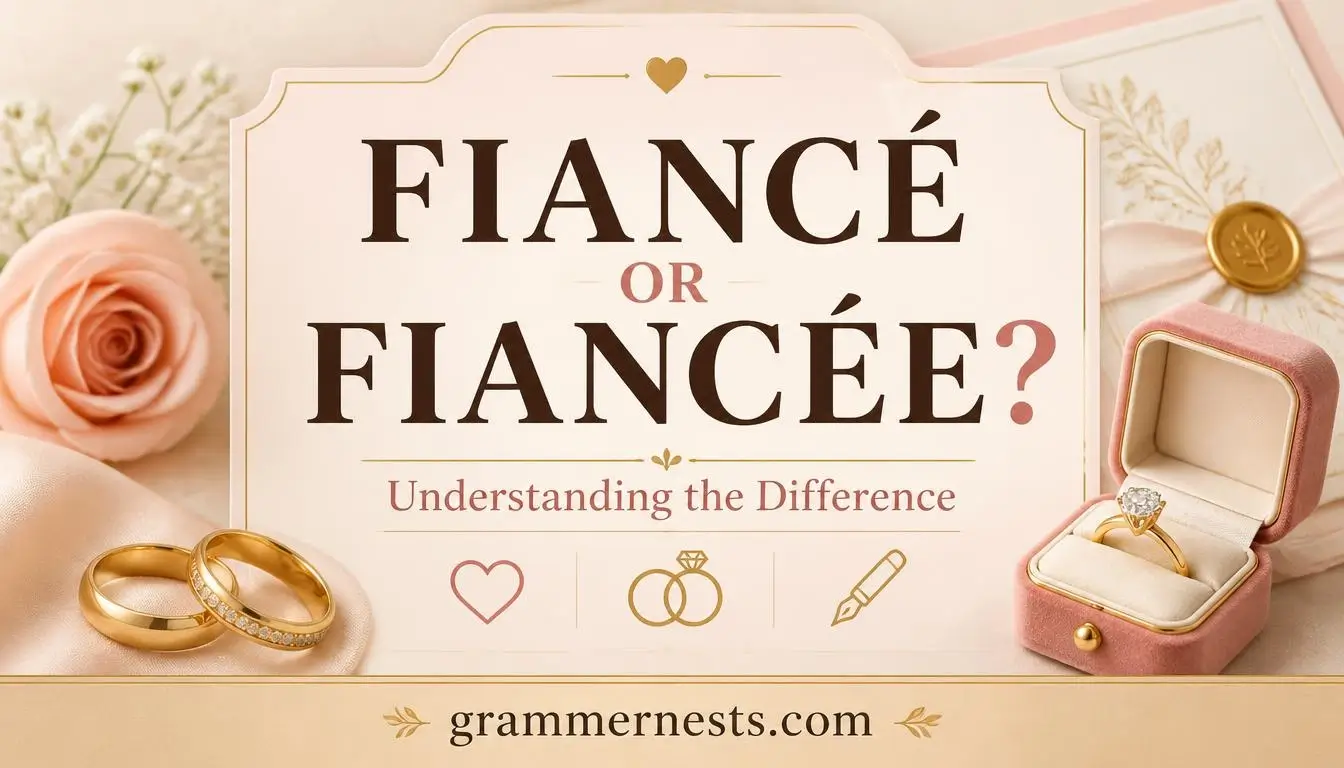
Have you ever wondered whether to write fiancé or fiancée when talking about someone who is engaged to be married?
These two words look almost identical, sound the same, and have the same basic meaning. However, there is one small spelling difference that changes how they are used.
The confusion comes from their French origin. In traditional English usage, to a man who is engaged to be married, while fiancée refers to a woman who is engagfiancé refersed to be married. The extra letter e at the end of fiancée marks the feminine form.
Although both spellings are correct, choosing the right one matters in emails, invitations, personal messages, and formal writing. Some people also leave out the French accent marks, which creates another spelling question.
Next, you will learn the difference between fiancé and fiancée, where these words came from, and how to use them correctly. You will also find practical examples, common mistakes, and advice for choosing the right spelling in American and British English.
Fiancé or Fiancée – Quick Answer
Both fiancé and fiancée are correct English words. The difference is the gender of the person who is engaged to be married.
- Fiancé: A man who is engaged to be married.
- Fiancée: A woman who is engaged to be married.
The easiest way to remember the difference is that fiancée has an extra e at the end.
Here are two simple examples:
- My fiancé is planning our wedding. (A man)
- Her fiancée bought her a beautiful engagement ring. (A woman)
Both words have the same pronunciation. The extra letter does not change how you say them.
You may also see these words written without accent marks:
- Fiance
- Fiancee
These forms are commonly accepted in English, especially in everyday digital writing. However, the accented forms are closer to the original French spelling.
The Origin of Fiancé and Fiancée
The words fiancé and fiancée come from the French language. They are related to the French verb fiancer, which means to promise someone in marriage or become engaged.
Both words became part of English during the 19th century. They developed from French forms that use different endings for masculine and feminine nouns.
The word fiancé is the masculine form. The word fiancée is the feminine form. French uses gendered word endings, so the extra e shows that the person being described is female.
The history of these words also connects to the idea of trust and promises. Their older roots are linked to the Latin word fidere, meaning to trust.
According to etymological records, fiancée appeared in English in the 19th century, followed by the masculine form fiancé in common English use. Both became established terms for people who had promised to marry.
Why Do the Spellings Have Different Endings?
The spelling difference comes from French grammar.
In French, many words change their endings to show gender. The feminine form often adds an extra e.
For example:
| Masculine form | Feminine form |
| Fiancé | Fiancée |
| Né | Née |
| Divorcé | Divorcée |
English does not usually change nouns in this way. However, it has kept the traditional gender distinction in these borrowed French words.
This is why fiancé and fiancée have different spellings even though they describe people in the same relationship stage.
British English vs American English Spelling
There is no major spelling difference between British English and American English when it comes to fiancé and fiancée.
Both varieties generally follow the traditional French spelling distinction:
- Fiancé refers to an engaged man.
- Fiancée refers to an engaged woman.
The main difference is not between American and British English. It is between the masculine and feminine forms.
Both American and British writers may also leave out the accent marks. This is common in informal writing, online messages, and situations where a keyboard makes accented letters difficult to type.
British English vs American English Comparison Table
| Word or feature | British English | American English |
| Engaged man | Fiancé | Fiancé |
| Engaged woman | Fiancée | Fiancée |
| Without accents | Fiance / Fiancee | Fiance / Fiancee |
| Pronunciation | Similar | Similar |
| Extra e | Marks feminine form | Marks feminine form |
| Formal writing | Accents preferred | Accents preferred |
Are Accent Marks Necessary?
The accent mark over the é is part of the original French spelling.
In English, however, it is generally acceptable to write these words without the accent:
- Fiancé or fiance
- Fiancée or fiancee
For example:
- My fiancé will arrive tomorrow.
- My fiance will arrive tomorrow.
Both versions are understandable in English.
Still, using the accent marks is a good choice in formal writing because it preserves the standard French-derived spelling.
Which Spelling Should You Use?
Your choice depends on the person you are describing and the audience reading your writing. The difference is based on gender, not location.
For American Readers
If you are writing for an American audience, use fiancé for an engaged man and fiancée for an engaged woman.
For example:
- My brother introduced his fiancée to our family.
- Her fiancé works as a doctor.
You can leave out the accent marks in casual writing, but keeping them is a good option for professional content.
British and Commonwealth Readers
British English follows the same traditional distinction.
Use fiancé when describing an engaged man and fiancée when describing an engaged woman.
The same rule applies in countries such as Canada, Australia, and New Zealand, where English writing generally recognizes both forms.
For Global Audiences
If you write for an international audience, using the correct traditional forms is a clear and reliable choice.
However, if you do not know someone’s gender or prefer not to use gender-specific language, you can choose a neutral alternative.
For example:
- My partner is getting married next year.
- My future spouse is arriving tomorrow.
- My betrothed is planning the wedding.
These expressions can help you avoid choosing between the two forms.
Common Mistakes with Fiancé and Fiancée
Although these words are easy to understand, people sometimes use them incorrectly. Most mistakes happen because writers forget the extra e or confuse the two forms.
Here are some common errors and their corrections.
1st. Using Fiancé for an Engaged Woman
Incorrect: My sister is meeting her fiancé tomorrow.
Correct: My sister is meeting her fiancée tomorrow.
The traditional feminine form is fiancée. It has an extra e at the end.
2nd. Using Fiancée for an Engaged Man
Incorrect: Her brother introduced his fiancée to us. (If the person is a woman, this sentence is correct; if the person is a man, it is incorrect.)
Correct: Her brother introduced his fiancé to us. (When referring to an engaged man.)
Always consider the person being described before choosing the spelling.
3rd. Forgetting the Accent Mark
Some writers think that fiance and fiancee are always spelling mistakes.
This is not true in English. The accent marks can be omitted in common English writing.
However, the accented versions are preferred when following the original French spelling.
4th. Thinking Both Words Sound Different
Incorrect idea: Fiancé and fiancée have different pronunciations.
Correct: Both words are pronounced the same way.
The difference is in their spelling and traditional meaning, not their pronunciation.
5th. Using the Wrong Form in Wedding Invitations
Incorrect: We invite you to celebrate the marriage of John and his fiancé, Sarah.
Correct: We invite you to celebrate the marriage of John and his fiancée, Sarah.
When referring to Sarah as an engaged woman, fiancée is the traditional choice.
6th. Confusing Fiancé with Husband or Wife
A fiancé or fiancée is not yet a husband or wife.
The terms describe someone who is engaged to be married. After the wedding, the person becomes a husband, wife, or spouse.
Fiancé and Fiancée in Everyday Examples
Understanding the difference becomes easier when you see these words in real-life situations.
Here are examples from different types of writing.
1st. In Emails
These words are common in personal and professional emails.
Examples:
- My fiancée and I would like to book a wedding venue.
- My fiancé will join me at the meeting.
- I would like to invite you and your fiancé to dinner.
2nd. In News Articles
News writers use these words when reporting on engagements, weddings, and personal events.
Examples:
- The actor announced his engagement to his fiancée.
- The couple shared their wedding plans with the public.
- The athlete thanked his fiancé for supporting his career.
3rd. On Social Media
People often use these words in engagement announcements, wedding pictures, and personal updates.
Examples:
- I cannot wait to marry my beautiful fiancée!
- My fiancé surprised me with the perfect proposal.
- Spending the weekend with my favorite person and future spouse.
4th. In Formal Writing
In formal documents, choose the correct traditional form and keep the spelling consistent.
Examples:
- The applicant will travel with his fiancée.
- She plans to attend the event with her fiancé.
- Both the applicant and their partner will attend the wedding ceremony.
5th. In Everyday Conversations
These words are also used in ordinary conversations with family and friends.
Examples:
- Have you met my fiancé?
- Her fiancée is very kind.
- My brother and his fiancée are getting married in June.
Fiancé or Fiancée – Google Trends and Usage Data
People search for both fiancé and fiancée because the words look almost the same. Many writers also want to know whether the extra e is necessary and whether the accent mark should be included.
Google Trends can help explore interest in these terms across different countries and over time. However, it is important to understand what its data actually shows.
Popularity by Country
Search interest can vary by country, language, and writing habits.
- United States: Both terms are relevant to wedding announcements, relationship discussions, and English spelling questions.
- United Kingdom: British readers also use the traditional masculine and feminine forms.
- Canada: Both spellings are recognized in Canadian English.
- Australia: The same traditional distinction is used in Australian English.
- Other English-speaking regions: Writers generally follow the same rule, although accent marks may be left out in informal writing.
These are language-use observations, not a verified ranking of search volume by country.
What Do People Search For?
Searches related to these words usually fall into a few common categories:
- Spelling questions: People want to know whether fiancé or fiancée is correct.
- Meaning questions: Readers want to understand what each word means.
- Gender differences: Some users are unsure which form describes a man or woman.
- Pronunciation: People want to know whether the words sound different.
- Writing advice: Users need the correct form for invitations, emails, and social media posts.
Fiancé vs Fiancée: Comparison Table
Here is a quick comparison of the main spelling variations and their meanings.
| Word | Meaning | Correct usage |
| Fiancé | A man engaged to be married | Yes |
| Fiancée | A woman engaged to be married | Yes |
| Fiance | An unaccented form of fiancé | Yes, in English |
| Fiancee | An unaccented form of fiancée | Yes, in English |
| Fiances | Plural of fiancé | Yes |
| Fiancées | Plural of fiancée | Yes |
| Fiancé(e) | A combined form when gender is unspecified | Yes, in some contexts |
Remember that fiancé and fiancée are the traditional forms. The unaccented spellings are also accepted in English, but the extra e still helps show the feminine form.
FAQs:
Is it fiancé or fiancée for a man?
Use fiancé for a man who is engaged to be married. It has one e at the end, following the accented letter.
Example: My fiancé is planning our wedding.
Is it fiancé or fiancée for a woman?
Use fiancée for a woman who is engaged to be married. It has an extra e at the end.
Example: My fiancée loves flowers.
Are fiancé and fiancée pronounced the same?
Yes. Both words have the same pronunciation in English. The extra e changes the spelling and traditional gender meaning, not the sound.
Can I write fiance without an accent?
Yes. English allows the unaccented spelling fiance. It is commonly used in everyday writing, online messages, and other informal situations.
However, fiancé is the traditional accented form.
Is fiancée with two e’s correct?
Yes. Fiancée is the correct traditional spelling for a woman who is engaged to be married. The final extra e marks the feminine form.
Do British and American English use different spellings?
No. Both British and American English use fiancé for an engaged man and fiancée for an engaged woman. There is no major regional spelling difference.
What is a gender-neutral alternative to fiancé or fiancée?
You can use words such as partner, future spouse, or betrothed when you want to avoid gender-specific language.
For example: My partner and I are getting married next year.
Conclusion:
Choosing between fiancé and fiancée is simple once you understand their spelling and meaning. Both words describe someone who is engaged to be married, but they traditionally refer to different genders. Use fiancé for an engaged man and fiancée for an engaged woman.
The easiest way to remember the difference is that fiancée has an extra e at the end. This follows the French spelling tradition, where the extra letter marks the feminine form.
There is no major difference between British and American English in how these words are used. Both varieties follow the same traditional rule. You can also leave out the accent marks in English, although keeping them is a good choice for formal writing.
If you are unsure which word to use or prefer gender-neutral language, consider alternatives such as partner or future spouse. Most importantly, choose the word that clearly describes the person you are talking about.
Read More Posts:
- Freshmen or Freshman: Meaning, Rules, and Examples Guide
- In Regard or In Regards: How to Use Each Word Correctly
- Awhile or A While: When to Use Each Expression 2026guide
Toni Morrison is a celebrated American novelist known for her powerful storytelling, rich characters, and lasting impact on literature. At GrammerNests.com, she shares insights that help readers appreciate language, writing, and literary expression.


3 thoughts on “Fiancé or Fiancée: Understanding the Gender Difference”