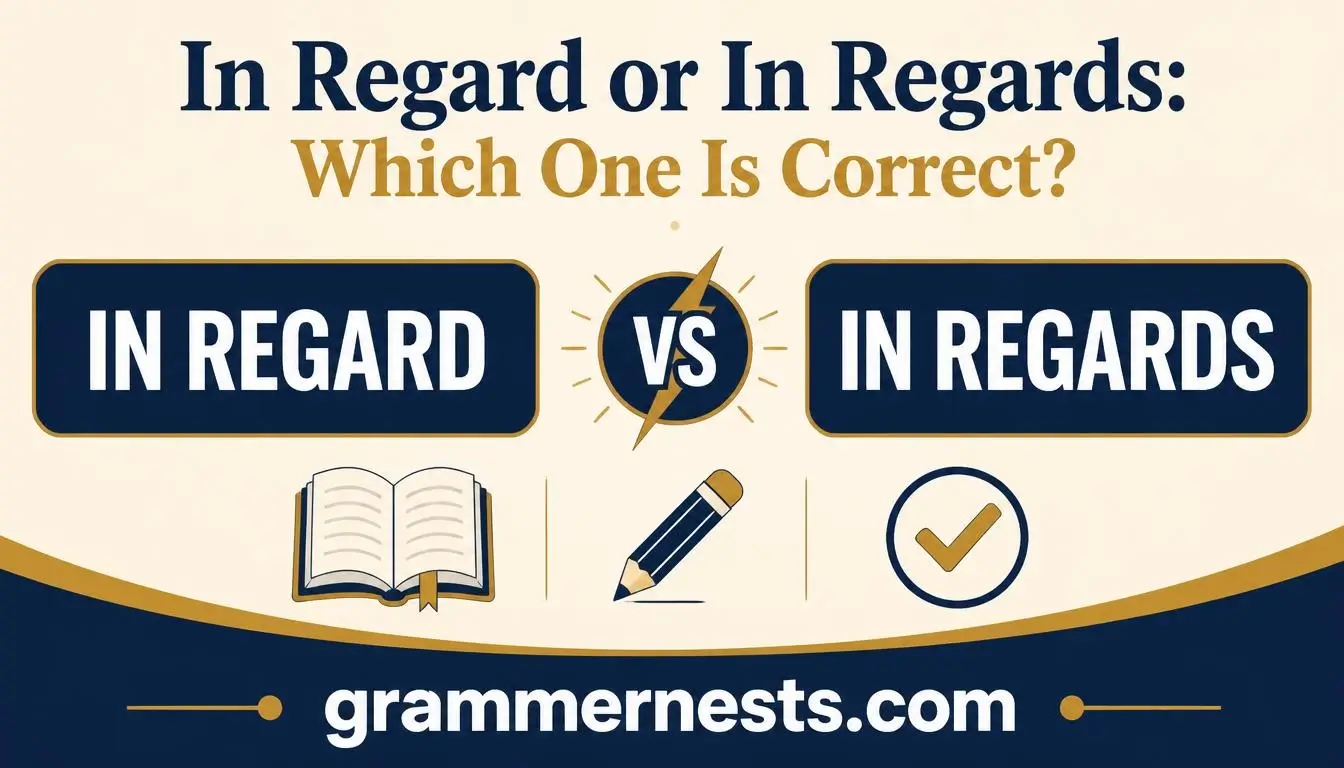
Have you ever stopped while writing an email because you were unsure whether to write in regard or in regards? You are not alone. Both expressions appear in everyday conversations, business emails, formal letters, and online articles.
Still, they can create confusion, especially when you want your writing to sound clear and professional.
The main difference is that in regard to is the standard expression, while in regards to is also widely used and accepted in modern English. Both mean concerning, about, or with reference to. However, traditional grammar guides often prefer the singular form.
Understanding the difference can help you avoid common writing mistakes. It can also make your emails, reports, and professional messages sound more natural.
If you are writing for an American, British, or international audience, choosing the right expression is easier when you know how each form works.
Next, we will explain the meaning, origin, spelling differences, common mistakes, and everyday uses of both expressions.
In Regard or In Regards – Quick Answer
Both in regard to and in regards to are used in English. However, in regard to is traditionally preferred in formal writing.
Both expressions mean:
- Concerning something.
- About a particular subject.
- With reference to something.
Examples:
- Correct: I am writing in regard to your recent application.
- Also used: I am writing in regards to your recent application.
For professional emails, academic writing, and formal documents, choose in regard to.
You can also use simpler alternatives such as about, concerning, or regarding.
Important: The phrase as regards is another correct expression. It has a slightly different grammatical structure.
The History of In Regard or In Regards
The expression in regard to comes from the word regard, which has a long history in the English language.
The word regard entered English through Old French, from the verb regarder, meaning to look at or observe. Its earlier roots are connected to the idea of watching or paying attention to something.
Over time, the meaning expanded. People began using regard to describe attention, consideration, respect, and interest in a particular subject.
This development led to expressions such as:
- In regard to
- With regard to
- As regards
- Without regard to
The word regards also became common as a noun and in expressions connected with attention or consideration.
Both in regard to and in regards to developed through English usage. The singular version became the traditional standard in formal writing, while the plural version gained widespread use in everyday communication.
Today, both forms are familiar to English speakers, although many editors still recommend the singular form.
British English vs American English Spelling
The expressions in regard to and in regards to do not follow the same spelling differences as words such as colour and color.
There is no standard British spelling and American spelling distinction here. Both expressions can be found in American and British English.
The main difference is related to style and usage rather than regional spelling rules.
American English
In American English, in regard to is widely used in formal and professional writing.
For example:
- In regard to your request, we will respond shortly.
- I have a question in regard to the new policy.
The plural version, in regards to, also appears in American conversations and informal writing.
British English
British English also uses in regard to in formal writing.
For example:
- In regard to your recent letter, we have reviewed the details.
- Please contact us in regard to this matter.
The expression in regards to is also understood in the UK, although some traditional style guides prefer the singular version.
British vs American Comparison Table
| Feature | American English | British English |
| In regard to | Standard | Standard |
| In regards to | Commonly used | Commonly used |
| With regard to | Standard | Standard |
| With regards to | Used | Used |
| Formal preference | In regard to | In regard to |
| Spelling difference | None | None |
Key takeaway: Neither country has a separate spelling rule for these expressions. The singular form is the safer choice for formal writing in both varieties.
Which Spelling Should You Use?
Your choice depends on your audience, writing style, and purpose.
Here is some simple advice.
1. For American English Readers
If you are writing for an American audience, use in regard to in business emails, academic papers, reports, and official documents.
Example:
“In regard to your recent inquiry, our team will contact you tomorrow.”
This version sounds clear and professional.
2. For British English Readers
British readers also understand and accept in regard to.
Use it in formal letters, workplace communication, and professional reports.
Example:
“In regard to the meeting, please review the attached document.”
3. For Canadian and Australian Readers
The singular form is also a suitable choice for Canadian and Australian English.
Example:
“In regard to your application, we need some additional information.”
It works well across Commonwealth English varieties.
4. For International Readers
If your writing is intended for a global audience, in regard to is a safe option.
However, you can make your sentences even simpler by using about or regarding.
For example:
- Formal: In regard to your question, we have prepared a response.
- Simple: Regarding your question, we have prepared a response.
- Direct: About your question, we have prepared a response.
Professional advice: Use in regard to when you want a traditional formal tone. Use regarding when you want shorter, smoother sentences.
Common Mistakes with In Regard or In Regards
Writers sometimes confuse these expressions because they look almost identical. However, a few simple rules can help you avoid errors.
1st. Adding an Extra S in Formal Writing
Some writers use in regards to in formal documents without realizing that traditional style guides prefer the singular version.
Less preferred in formal writing:
“In regards to your request, we need more information.”
Recommended:
“In regard to your request, we need more information.”
2nd. Forgetting the Word To
The expression usually needs to when introducing a subject.
Incorrect:
“I am writing in regard your complaint.”
Correct:
“I am writing in regard to your complaint.”
3rd. Confusing In Regard To With As Regards
These expressions are both correct, but their structures are different.
Examples:
- In regard to your email, we have an update.
- As regards your email, we have an update.
Do not combine their structures incorrectly.
4th. Using Regards Instead of Regard
The word regards is also used to express good wishes at the end of an email.
For example:
“Kind regards,”
This is different from the expression in regard to.
5th. Using the Phrase Too Often
Repeating in regard to several times can make your writing sound unnatural.
Repetitive:
“In regard to your order, we have a question. In regard to delivery, we need more details.”
Better:
“We have a question about your order and need more details about delivery.”
6th. Confusing With Regard To and With Regards To
Both forms appear in modern English.
However, with regard to is the traditional formal choice.
Example:
“With regard to your application, we will provide an update soon.”
In Regard or In Regards in Everyday Examples
Both expressions appear in different types of writing. Understanding their use in real situations can help you choose the right phrase.
1st. In Business Emails
Business emails should be clear, polite, and professional.
Examples:
- In regard to your recent message, I have attached the requested information.
- In regard to the meeting, please confirm your availability.
- With regard to your payment, we will send an update shortly.
The singular form works especially well in formal business communication.
2nd. In News Articles
News writers use these expressions when discussing a particular subject or issue.
Examples:
- The government released a statement in regard to the new policy.
- Officials provided additional information with regard to the investigation.
- The report raised several questions regarding public safety.
In news writing, regarding is often a shorter alternative.
3rd. On Social Media
Social media posts usually have a more relaxed tone.
Examples:
- I have a question in regard to the latest update.
- Just sharing my thoughts in regards to the new announcement.
- Any news regarding the event?
The plural expression may appear in casual posts, but in regard to remains a suitable choice.
4th. In Formal Letters
Formal letters often use traditional expressions.
Examples:
- I am writing in regard to your recent advertisement.
- With regard to your request, please find the attached document.
- We would like to provide further details in regard to this matter.
These expressions help establish a polite and professional tone.
5th. In Academic Writing
Academic writing usually benefits from precise and direct language.
Examples:
- The study provides further information in regard to social behavior.
- The researchers examined several issues with regard to education.
- The findings offer useful details regarding public health.
For academic work, regarding and with regard to are useful alternatives.
In Regard or In Regards – Trends & Usage Data
People search for in regard or in regards because they want to know which expression is grammatically correct.
The confusion is understandable because both forms appear in published writing, workplace communication, and online discussions.
Which Version Is More Popular?
The singular expression in regard to has a long history in formal English. The plural expression in regards to is also common in everyday communication.
However, popularity and grammatical preference are not always the same.
A phrase may appear frequently in online searches and conversations without being the preferred option in formal writing.
Usage by Country
| Country | Common Usage | Formal Recommendation |
| United States | Both forms | In regard to |
| United Kingdom | Both forms | In regard to |
| Canada | Both forms | In regard to |
| Australia | Both forms | In regard to |
| New Zealand | Both forms | In regard to |
| India | Both forms | In regard to |
These are general usage observations, not measured country rankings.
What Does Google Trends Tell Us?
Google Trends can help compare search interest for phrases such as:
- In regard or in regards
- In regard to
- In regards to
- With regard to
- With regards to
To understand their popularity, compare the terms over the same period and in the same country.
Keep in mind that Google Trends reports relative search interest, not the total number of searches or grammatical correctness.
SEO tip: If you are writing an article about this topic, include both variations naturally. This helps address readers who search for either version.
In Regard vs In Regards: Comparison Table
The following table explains the main differences between the expressions.
| Expression | Meaning | Usage | Formal Recommendation |
| In regard to | Concerning | Formal and general | Preferred |
| In regards to | Concerning | General and informal | Less preferred |
| With regard to | Concerning | Formal | Preferred |
| With regards to | Concerning | General | Less preferred |
| As regards | Concerning | Formal and general | Correct |
| Regarding | About | All writing styles | Preferred |
| About | Concerning | Everyday English | Preferred |
Examples Side by Side
| Less Preferred | Recommended |
| In regards to your email | In regard to your email |
| In regards to the issue | In regard to the issue |
| With regards to the meeting | With regard to the meeting |
| In regards to your order | Regarding your order |
| In regards to the report | About the report |
Remember that in regards to is widely used and understood. The recommended versions simply follow traditional formal usage.
FAQs:
Is It In Regard or In Regards?
Both expressions are used in English. However, in regard to is the traditional and preferred form in formal writing. It means concerning or about something.
Is In Regards to Grammatically Correct?
Yes. In regards to is widely used in modern English and is generally understood. However, traditional grammar and style guides usually recommend in regard to for formal communication.
Is In Regard to More Formal Than In Regards To?
Yes. In regard to is generally considered the more formal and traditional option. It is a better choice for business emails, official letters, academic papers, and professional reports.
Should I Use In Regard or In Regards in an Email?
Use in regard to in professional emails. It sounds formal and follows traditional usage.
Example:
“In regard to your recent request, I have attached the required documents.”
What Is Another Word for In Regard To?
You can use several alternatives, depending on your sentence:
- Regarding
- Concerning
- About
- With reference to
- In connection with
- As for
For simple writing, about and regarding are usually the easiest choices.
Is With Regard To or With Regards To Correct?
Both expressions appear in modern English. However, with regard to is the traditional standard form and is preferred in formal writing.
Example:
“With regard to your application, we will contact you soon.”
Can I Use In Regards To in Academic Writing?
It is better to use in regard to, with regard to, or regarding in academic writing. These forms are more consistent with traditional formal style. Always follow your university’s or publisher’s style guide.
Conclusion:
Understanding the difference between in regard and in regards can help you write with greater confidence. Both expressions are used in modern English, and both communicate the idea of concerning or referring to a particular subject.
However, in regard to is the traditional form and remains the preferred choice in formal writing.
Whether you are preparing a business email, writing an academic paper, or sending an official letter, the singular version is a safe option.
British and American English follow similar usage patterns, so you do not need to worry about a regional spelling difference.
You can also use alternatives such as regarding, concerning, or about to make your sentences shorter and easier to understand. The most important thing is to keep your writing clear and natural.
When in doubt, choose in regard to for professional communication. It is widely understood, grammatically established, and suitable for readers across different English-speaking countries.
Read More Posts:
- Tomatoes or Tomatos in American and British English
- Can Onto and On To Be Used Interchangeably? Guide 2026
- Is Blond Gender-Neutral in Modern English? 2026guide





1 thought on “In Regard or In Regards: How to Use Each Word Correctly”