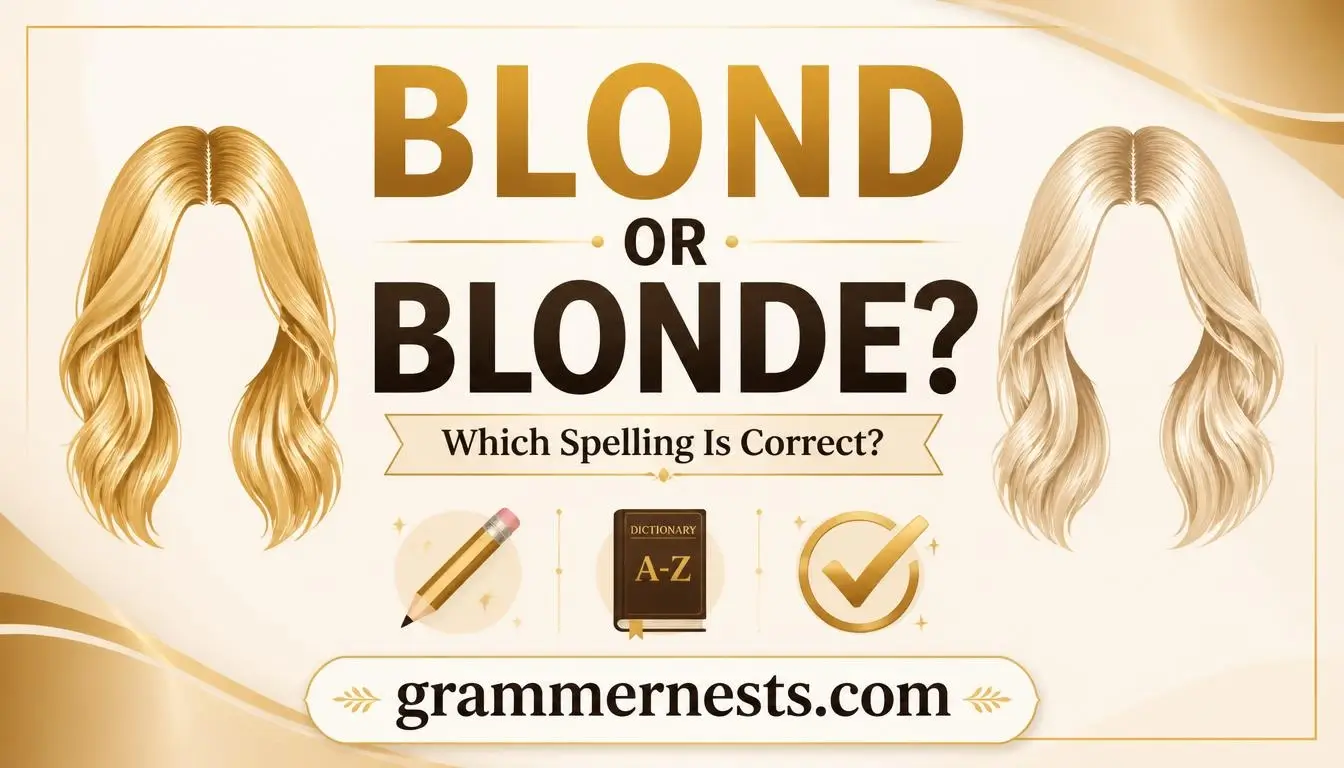
Have you ever wondered whether to write blond or blonde? Both spellings are correct, but choosing the right one can be confusing. You may see blond hair in one article and blonde hair in another.
This difference can make you question which spelling is correct and whether it depends on gender, location, or writing style.
The words blond and blonde describe a light yellow or golden hair color. Traditionally, blond refers to a man or a masculine noun, while blonde refers to a woman or a feminine noun. However, modern English, especially American English, often uses blond as a gender-neutral adjective.
The difference is useful to understand when writing emails, blog posts, school assignments, news articles, or professional documents. Your choice may depend on your audience and the style guide you follow.
In this guide, you will learn the meaning, history, spelling rules, and common mistakes involving blond or blonde. You will also find simple examples to help you choose the correct form with confidence.
Blond or Blonde – Quick Answer
Both blond and blonde are correct English spellings. They describe someone or something with fair, golden, or light-colored hair.
The traditional difference is based on gender:
- Blond: Traditionally used for men and masculine nouns.
- Blonde: Traditionally used for women and feminine nouns.
In modern American English, blond is commonly used as a gender-neutral adjective. Blonde is also widely accepted, especially when referring to a woman.
Examples:
- He has blond hair.
- She has blonde hair.
- The blond boy is my cousin.
- The blonde woman is a teacher.
- She decided to dye her hair blond.
Quick tip: Use blond for general or gender-neutral descriptions. Use blonde when following the traditional feminine form.
The Evolution of Blond or Blonde
The word blond entered English during the 15th century. It came from the Old French word blont, which described fair or light-colored hair. Its deeper origin is uncertain, but it may come from a Germanic language. The word is also linked to the Medieval Latin blundus, meaning yellow.
The spelling blonde developed from the French feminine form of blond. French uses grammatical gender, so many adjectives change their endings depending on whether they describe a masculine or feminine subject.
English adopted both forms and kept much of this old spelling pattern.
Here is how the difference developed:
- 15th century: English began using blond to describe fair or golden hair.
- Later centuries: The feminine French form blonde became common in English.
- Modern English: Both spellings remain in use, but their rules vary by region and writing style.
Unlike French, modern English does not usually assign grammatical gender to nouns. This is why many American writers now prefer blond for everyone.
British English vs American English Spelling
British and American English both accept blond and blonde. However, their common writing habits are slightly different.
British English
British English traditionally follows the French gender distinction:
- Blond for a man or boy.
- Blonde for a woman or girl.
- Blonde hair is common when describing a woman’s hair.
Some British writers also use blonde more broadly. Therefore, the feminine form is not limited to descriptions of women in every British publication.
American English
American English often prefers blond as a general adjective, regardless of gender.
For example:
- She has blond hair.
- He has blond hair.
- The blond child smiled.
The spelling blonde remains common when referring to a woman, particularly as a noun.
The Associated Press style convention also uses blond as an adjective for all applications.
Columbia Journalism Review+2
British vs American spelling comparison
| Writing situation | British English | American English |
| Man’s hair | Blond hair | Blond hair |
| Woman’s hair | Blonde hair | Blond hair (also blonde) |
| A man | A blond man | A blond man |
| A woman | A blonde woman | A blonde woman |
| General hair color | Blond or blonde | Usually blond |
| Light-colored wood | Blond wood | Blond wood |
Important: These are common preferences, not strict rules that every writer follows. Both forms are understood in the UK and the US.
Which Spelling Should You Use?
The best spelling depends on your audience, the person you are describing, and your preferred writing style.
Here is some practical advice.
1st. If You Are Writing for a US Audience
Choose blond as your general adjective. It is simple, widely accepted, and works for People of all genders.
Examples:
- She has beautiful blond hair.
- He is a blond actor.
- The child has blond curls.
You can still use blonde as a noun when referring to a woman, but avoid using it if your style guide prefers gender-neutral language.
2nd. If You Are Writing for a UK Audience
You can follow the traditional distinction:
- Use blond for men.
- Use blonde for women.
For example:
- The blond man is a doctor.
- The blonde woman is a writer.
This approach is familiar to many British readers.
3rd. If You Are Writing for a Commonwealth Audience
Countries such as Canada, Australia, and New Zealand may follow different editorial preferences.
Some publications use the traditional gender distinction, while others prefer blond as a general adjective.
Check the dictionary or style guide used by your publication.
4th. If You Are Writing for a Global Audience
Use blond when you need a simple, gender-neutral adjective.
For example:
- The model has blond hair.
- The child has natural blond curls.
This spelling is clear and widely understood.
Professional recommendation: If you manage a US-focused website or blog, use blond as your default adjective. Use blonde when it fits a traditional feminine noun or a specific style choice. Keep your spelling consistent throughout the article.
Common Mistakes with Blond or Blonde
Many writers understand the meaning but still make mistakes when choosing between these two forms.
Here are some common errors and their corrections.
Mistake 1st: Thinking One Spelling Is Always Wrong
Incorrect: Blonde is always wrong in American English.
Correct: Both spellings are accepted in American English.
Blond is often preferred as a general adjective, but blonde is also widely used.
Mistake 2nd: Using Blonde for Every Man
Incorrect: He is a blonde man.
Better: He is a blond man.
The traditional gender rule uses blond for men. Some modern writers use blond for all genders.
Mistake 3rd: Assuming Blond Only Describes Men
Incorrect: A woman cannot have blond hair.
Correct: She has blond hair.
American English commonly uses blond for women’s hair too.
Mistake 4th: Confusing the Adjective and Noun
An adjective describes a person or thing. A noun names a person or thing.
Examples:
- Adjective: She has blonde hair.
- Noun: She is a blonde.
However, referring to a woman simply as a blonde may sound outdated or reduce her identity to her appearance. It is usually better to write a woman with blonde hair.
Mistake 5th: Using the Wrong Spelling for Wood
Incorrect: The table is made of blonde wood.
Better: The table is made of blond wood.
When describing light-colored wood, blond is the usual spelling.
Mistake 6th: Changing Spellings Without a Reason
Incorrect: She has blond hair. Her blonde curls look beautiful.
Better: She has blond hair. Her blond curls look beautiful.
Choose a spelling system and follow it consistently.
Blond or Blonde in Everyday Examples
Understanding real-life examples makes the difference easier to remember. Both forms appear in everyday writing, including emails, news reports, social media, and professional documents.
1. In Emails
You may need these words when describing someone’s appearance or giving details about a person.
Examples:
- The new employee has short blond hair.
- I met a woman with beautiful blonde hair.
- The photo shows a blond man standing near the door.
For professional emails, describe the person clearly and respectfully.
2. In News Articles
News writers use these words to describe people, characters, or physical features.
Examples:
- The blond actor appeared at the film premiere.
- A blonde woman spoke to reporters.
- The singer changed her hair color to platinum blond.
News publications may follow different style guides, so their spelling choices can vary.
3. On Social Media
Social media users often choose either spelling, depending on their personal style.
Examples:
- Loving my new blond hair!
- Going blonde for the summer.
- Natural blonde curls are beautiful.
- Should I try a darker shade of blond?
Both spellings are easy to understand in casual conversations.
4. In Formal Writing
In academic papers, business reports, and professional articles, consistency matters.
Examples:
- The character is described as a blond young man.
- The painting shows a woman with blonde hair.
- The furniture has a smooth, blond wood finish.
Use the spelling preferred by your institution or publication.
Comparison Table: Blond vs Blonde
| Feature | Blond | Blonde |
| Meaning | Light golden hair color | Light golden hair color |
| Traditional gender | Masculine | Feminine |
| US usage | Common general adjective | Common for women |
| UK usage | Common for men | Common for women |
| Adjective | Yes | Yes |
| Noun | Yes | Yes |
| Wood color | Preferred | Less usual |
| Pronunciation | Same | Same |
Both words have the same pronunciation. The final e changes the spelling, not the sound.
Blond or Blonde – Trends & Usage Data
People search for blond or blonde because they want to know which spelling is correct. The question is especially common among students, bloggers, editors, English learners, and people writing about hair color.
Google Trends can help writers understand how people search for these terms across different countries.
However, it is important to understand what the data actually shows.
1. Popularity by Country
Search interest can vary between countries because English spelling habits differ.
For example:
- United States: Blond is commonly preferred as a general adjective.
- United Kingdom: Both forms are common, with a stronger traditional gender distinction.
- Canada: Both spellings are understood, and editorial preferences may vary.
- Australia: Both forms are used, with traditional and modern preferences.
- New Zealand: Both spellings are recognized in everyday English.
These are spelling and usage patterns, not verified Google Trends country rankings.
2. Why Do People Search for Both Words?
Several common situations explain the interest:
- Grammar questions: People want to know whether the final e is necessary.
- Hair color: Users search for the correct spelling when discussing hair dye or natural hair.
- School assignments: Students want to avoid spelling errors.
- Professional writing: Editors need consistent spelling.
- English learning: Non-native speakers want to understand the difference.
3. How to Check Google Trends
You can compare both search terms using Google Trends.
Follow these steps:
- Open Google Trends.
- Enter blond in the search box.
- Add blonde using the comparison option.
- Select your preferred country.
- Choose a time range, such as the past 12 months or five years.
- Review the interest-over-time graph and regional results.
Google Trends uses a normalized scale from 0 to 100. These values show relative search interest, not the exact number of searches.
FAQs:
Is it blond or blonde?
Both spellings are correct. Traditionally, blond describes men and blonde describes women. American English often uses blond for all genders.
Is blonde with an E grammatically correct?
Yes. Blonde is grammatically correct. It is traditionally the feminine form of blond and is commonly used to describe a woman with fair or golden hair.
Should I write blond hair or blonde hair?
Both expressions are correct. American English often prefers blond hair, while British English commonly uses blonde hair when describing a woman’s hair.
Is blond used for males only?
No. Although blond traditionally describes males, modern American English uses it as a gender-neutral adjective for men, women, and children.
What is the plural of blonde?
The plural of blonde is blondes. For example, “The two blondes are sisters.” However, blond can also be used as a plural noun when referring to people of any gender.
Is blonde American or British English?
Both American and British English use blonde. However, British English traditionally follows the masculine and feminine distinction, while American English often prefers blond as a general adjective.
Is blond or blonde more professional?
Both are professional and acceptable. The best choice depends on your audience and style guide. For general American English writing, blond is a practical choice because it works for all genders.
Conclusion:
Choosing between blond or blonde becomes easy once you understand their history and spelling rules. Both words describe fair, light golden, or yellowish hair, and neither spelling is incorrect.
Traditionally, blond is the masculine form, while blonde is the feminine form. This distinction comes from French, where adjectives can change according to grammatical gender. British English often follows this traditional pattern, while American English commonly uses blond as a gender-neutral adjective.
If you write for an American audience, blond is a simple and widely accepted choice. For British readers, you can use blond for men and blonde for women.
If your audience is international, choose one clear spelling style and use it consistently.
Remember that context matters. Both spellings are correct, and the final choice depends on your audience, writing style, and purpose. Once you know these simple differences, you can use both words confidently in everyday and professional writing.
Read More Posts:
- Laying vs Lying Down: Simple Grammar Rules
- How to Use Patient and Patience in a Sentence Guide 2026
- Is It Capital or Capitol When Talking About Government?