The correct spelling can be confusing when you want to show surprise, excitement, or amazement.
Should you write “whoa” or “woah”? Both spellings appear in text messages, social media posts, songs, and everyday conversations. This makes it hard to know which one is right.
The good news is that both forms are widely understood. However, they do not have the same level of acceptance in standard English.
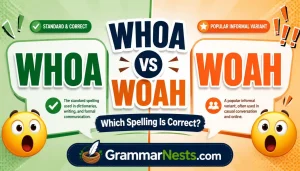
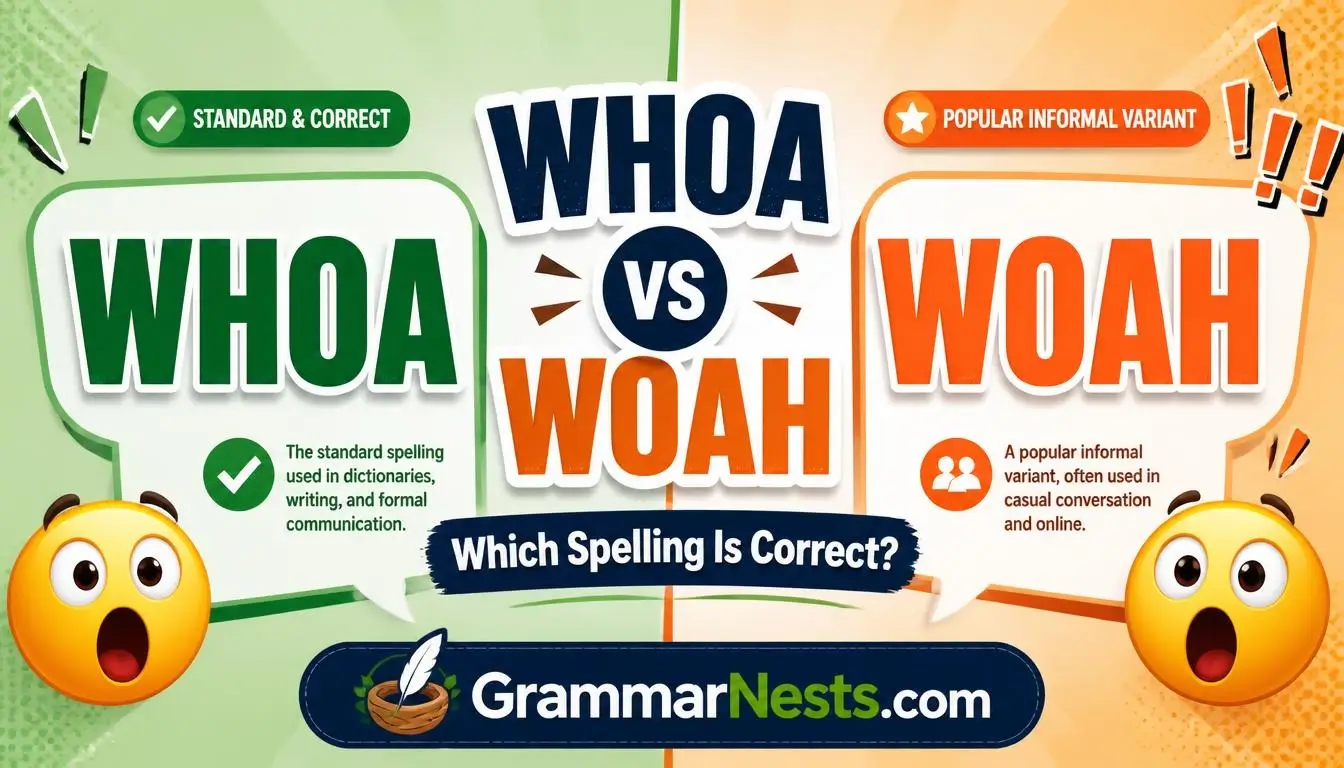
“Whoa” is the traditional and widely accepted spelling. “Woah” is a popular informal variation that many people use online.
You may see both forms when someone reacts to shocking news, sees something amazing, or wants another person to slow down. But the spelling you choose can affect how your writing looks to readers.
Next, learn the difference between whoa and woah, their history, and how people use them in American and British English.
You will also learn which spelling works best in emails, schoolwork, social media, and professional writing.
Whoa or Woah – Quick Answer
“Whoa” is the standard and preferred spelling. “Woah” is an informal variant used mainly in casual writing and online conversations.
Both words express surprise, excitement, amazement, or a request to stop or slow down. However, most dictionaries recognize “whoa” as the standard form.
Examples:
- Whoa! That was an amazing performance.
- Whoa! Please slow down.
- Whoa! I did not expect that news.
- Woah! Your new car looks amazing.
Use whoa in formal writing, school assignments, professional emails, and standard American or British English. You can use woah in casual messages or social media posts when you prefer an informal tone.
| Spelling | Status | Best use |
| Whoa | Standard spelling | Formal and informal writing. |
| Woah | Informal variant | Texting and social media. |
Easy rule: When in doubt, choose “whoa.” It is the safest spelling for almost every situation.
The Evolution of Whoa or Woah
The word “whoa” has a long history in the English language. It developed from an older expression used to stop or slow down horses and other animals.
In the past, people needed short commands to control horses while riding or working. “Whoa” became a common sound for asking an animal to stop, stand still, or slow down.
Over time, the word became part of everyday English. People began using it outside horse riding to express surprise, shock, or excitement.
For example:
- Whoa! That horse is moving fast.
- Whoa! I cannot believe what happened.
- Whoa! That is a huge house.
The spelling “woah” became popular as an alternative form. Its use grew through informal writing, music, online conversations, and social media.
People may choose “woah” because it looks or feels different. However, this spelling does not replace the standard form in most dictionaries and formal writing.
Today, both forms are easy to understand, but “whoa” remains the preferred spelling in standard English.
British English vs American English Spelling
One common question is whether Americans and British people spell the word differently.
The answer is simple: American and British English both use “whoa” as the standard spelling.
Unlike words such as “color” and “colour,” whoa does not have a separate standard spelling in these two varieties of English.
“Woah” appears in writing from both countries, but it is generally treated as an informal variant rather than a regional spelling rule.
Spelling Comparison Table
| Feature | American English | British English |
| Standard spelling | Whoa | Whoa |
| Informal variant | Woah | Woah |
| Meaning | Surprise or stop | Surprise or stop |
| Formal writing | Whoa | Whoa |
| Casual texting | Both appear | Both appear |
Examples in American English
- Whoa! That movie was incredible.
- Whoa, wait a minute!
- Whoa! You finished the project already?
Examples in British English
- Whoa! That was a close call.
- Whoa, slow down a little.
- Whoa! I did not see that coming.
There is no major difference in meaning between the American and British uses. The main difference is the level of formality, not the country.
Which Spelling Should You Use?
Choosing between whoa and woah depends on your audience and the type of writing.
If you want your writing to look correct and professional, “whoa” is the better choice. It is widely accepted and understood by English speakers around the world.
1st. For American Readers
Use “whoa” when writing for an American audience.
It is the standard spelling in American English and works well in professional documents, school assignments, articles, and everyday messages.
Example:
“Whoa! That was the best game I have ever watched.”
2nd. For British and Commonwealth Readers
British English also uses “whoa” as the standard form.
If you are writing for readers in the United Kingdom, Canada, Australia, or other English-speaking countries, “whoa” is a safe choice.
Example:
“Whoa! That was a surprising result.”
3rd. For Global Readers
If your website, blog, or social media account targets people from different countries, choose “whoa.”
It is the more established spelling and is less likely to look like a spelling mistake.
4th. For Social Media and Text Messages
You can use either spelling in casual conversations.
Some people prefer “woah” because it gives their message a playful or relaxed feel. Others use “whoa” because it is more familiar.
Examples:
- Whoa, this looks amazing!
- Woah, I love your new shoes!
- Whoa! What just happened?
5th. For Professional Writing
Always choose “whoa” when you need a standard spelling.
It is suitable for:
- Business emails
- School essays
- News articles
- Website content
- Professional reports
- Formal presentations
Best advice: Use “whoa” as your default spelling. Save “woah” for informal situations where style matters more than standard spelling.
Common Mistakes with Whoa or Woah
People sometimes use these spellings without knowing which one is standard. Here are some common mistakes and how to avoid them.
1st. Thinking Woah Is the Only Correct Spelling
Some people believe “woah” is correct because they see it frequently online.
However, “whoa” is the established standard spelling.
Incorrect assumption: Woah is the only correct form.
Better understanding: Whoa is standard, while woah is an informal variant.
2nd. Using Woah in Formal Writing
Using “woah” in a professional report or academic assignment may look informal.
Less suitable: Woah! The results were unexpected.
Better: Whoa! The results were unexpected.
3rd. Thinking Both Words Have Different Meanings
Both spellings express similar ideas. There is no widely accepted difference in meaning between them.
Example:
- Whoa! That is incredible.
- Woah! That is incredible.
Both communicate surprise.
4th. Confusing Whoa with Other Expressions
Some people confuse “whoa” with “wow” or “woah.”
Although they can express similar feelings, their uses are slightly different.
- Whoa: Expresses surprise or tells someone to stop.
- Wow: Expresses amazement or admiration.
- Woah: Informal spelling variant of whoa.
5th. Using Different Spellings in the Same Article
Switching between “whoa” and “woah” without a clear reason can make your writing look inconsistent.
Choose one spelling and use it throughout your content.
Whoa in Everyday Examples
The word “whoa” appears in many situations. It can show surprise, excitement, disbelief, or a request to stop.
Here are examples from different types of writing.
1st. In Emails
You can use “whoa” in friendly emails when the tone is relaxed.
Examples:
- Whoa! That is great news. Congratulations!
- Whoa, I did not expect the project to finish so early.
- Whoa! Your presentation was impressive.
For formal business emails, consider using expressions such as “That is surprising” or “I am impressed” instead.
2nd. In News Articles
Writers may use “whoa” in headlines, quotations, or informal reports to show a strong reaction.
Examples:
- Whoa! Fans React to an Unexpected Game Result
- The Crowd Shouted, “Whoa!” After the Amazing Performance.
- “Whoa, that was unexpected,” one visitor said.
News writing usually keeps the word in quotation marks or uses it in a casual headline.
3rd. On Social Media
Social media is one of the places where both spellings appear.
Examples:
- Whoa! This view is beautiful.
- Woah, that is a huge achievement!
- Whoa, I need to watch this again.
- Woah! What an amazing surprise.
Both forms work in casual posts, comments, and captions.
4th. In Formal Writing
Although “whoa” is a standard spelling, the word itself can sound conversational.
Examples:
- The rider shouted, “Whoa!” to stop the horse.
- The driver yelled, “Whoa!” as the vehicle approached the barrier.
In academic or highly formal writing, you may choose a more precise phrase instead.
For example:
- Informal: Whoa! The results were surprising.
- Formal: The results were highly unexpected.
5th. In Daily Conversations
People use “whoa” when something catches their attention.
Examples:
- Whoa! You look different.
- Whoa! That was close.
- Whoa, take it easy.
- Whoa! I cannot believe you won.
The word is useful because it communicates a strong reaction with very little effort.
Whoa or Woah – Trends & Usage Data
Both spellings appear in online searches, but “whoa” is the more established form in standard English.
“Woah” is also widely seen in casual writing, especially in messages, comments, and social media posts.
Google Trends can help writers compare interest in the two spellings across different countries and time periods. However, it is important to understand what the data shows.
1st. Which Spelling Is More Popular?
“Whoa” has stronger support in traditional dictionaries and standard writing. Merriam-Webster lists “woah” as a less common variant of “whoa.”
“Woah” also appears in modern English writing. Collins Dictionary recognizes it as a variant spelling.
2nd. Popularity by Country
Readers in the United States, United Kingdom, Canada, and Australia use both spellings. There is no reliable evidence here to establish that one country consistently prefers “woah” over “whoa.”
| Country | Standard spelling | Informal spelling |
| United States | Whoa | Woah |
| United Kingdom | Whoa | Woah |
| Canada | Whoa | Woah |
| Australia | Whoa | Woah |
| New Zealand | Whoa | Woah |
These are spelling recommendations, not measured country-by-country search rankings.
3rd. How to Compare Both Spellings on Google Trends
You can check their search interest yourself:
- Open Google Trends.
- Enter “whoa” as your first search term.
- Add “woah” as the second search term.
- Select your preferred country or choose worldwide.
- Set a time range, such as the past 12 months or five years.
- Compare the interest graphs.
Google Trends uses a normalized scale from 0 to 100. These numbers represent relative search interest, not the actual number of searches.
Important: Google explains that spelling variations and misspellings may not be included automatically in an exact search-term comparison. Therefore, do not treat a single Trends graph as a complete measure of how frequently people use each spelling.
Whoa vs Woah – Comparison Table
Here is a quick side-by-side comparison to help you understand both forms.
| Feature | Whoa | Woah |
| Standard spelling | Yes | No |
| Informal use | Yes | Yes |
| Meaning | Surprise or stop | Surprise or stop |
| Pronunciation | Same | Same |
| Dictionary recognition | Standard entry | Variant spelling |
| Professional writing | Recommended | Avoid |
| Social media | Suitable | Suitable |
| Text messages | Suitable | Suitable |
| American English | Standard | Informal |
| British English | Standard | Informal |
The main difference is spelling, not meaning. Both forms can express surprise, excitement, or a request to stop.
FAQs:
Is Whoa or Woah Correct?
“Whoa” is the standard and preferred spelling. “Woah” is an informal variant that people commonly use in online conversations and casual messages.
Is Woah a Real Word?
Yes. Major dictionaries, including Collins, recognize “woah” as a variant spelling of “whoa.” However, “whoa” remains the standard choice.
Why Do People Spell Whoa as Woah?
People may write “woah” because they see it on social media, in messages, or in popular culture. It has become a familiar informal spelling, even though “whoa” is the traditional form.
Do Whoa and Woah Have the Same Meaning?
Yes. Both spellings express surprise, excitement, amazement, or a request to stop or slow down.
Example:
- Whoa! That is incredible.
- Woah! That is incredible.
Both sentences communicate the same reaction.
Is Whoa More Common in American or British English?
“Whoa” is the standard spelling in both American and British English. Neither country has a separate official spelling rule for this word.
Can I Use Woah in a Professional Email?
It is better to use “whoa” if you want to include this expression in a professional email. However, in very formal communication, phrases such as “That is surprising” or “I am impressed” may sound more appropriate.
Should I Use Whoa or Woah on Social Media?
You can use either spelling on social media. “Whoa” is the standard option, while “woah” gives your message a casual and informal feel.
For example:
“Whoa! This is the best news ever!”
“Woah! I cannot believe it!”
Both are easy to understand.
Conclusion:
Choosing between whoa and woah is easy once you understand their difference. Both spellings express surprise, excitement, amazement, or a request to stop. However, they do not have the same status in standard English.
“Whoa” is the correct and preferred spelling for everyday and professional writing. It is accepted in both American and British English and is the safest option for a wide audience.
“Woah” is an informal variant. You may see it in text messages, social media posts, comments, and casual conversations. Most readers understand it, but it is less suitable for formal documents.
Remember that neither spelling changes the meaning or pronunciation of the expression. The main difference is how widely each form is accepted in standard writing.
If you are writing an email, school assignment, blog post, or professional article, choose “whoa.” If you are chatting with friends, either form can work.
The easiest rule to remember is simple: Use whoa for standard English and woah for casual expression.
Read More Posts:
- Toward or Towards in American and British English (2026Guide)
- English or Spanish: Language Comparison (2026Guide)
- Bear With Me or Bare With Me: Easy Way to Remember Guide