The difference between into and in to can be confusing, especially when both forms sound similar in a sentence.
Although they look almost identical, they serve different grammatical purposes and can change the meaning of your writing.
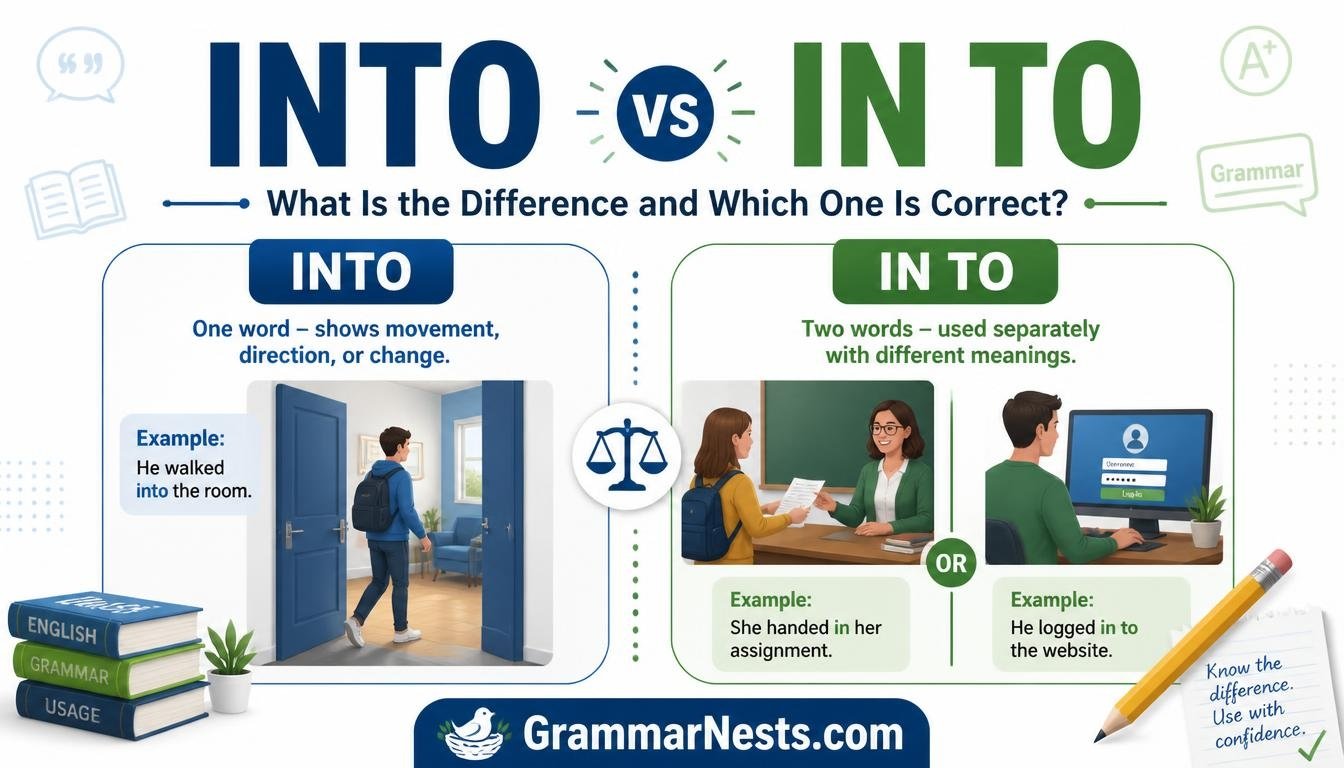
Into is a preposition that usually describes movement toward or inside something, while in to consists of two separate words that belong to different parts of a sentence.
For example, “She walked into the room” describes movement, whereas “He turned his homework in to the teacher” shows how the words in and to work independently.
Understanding this distinction can help you avoid grammatical mistakes and make your writing clearer.
If you are writing school assignments, professional emails, reports, or everyday messages, knowing when to use each form is an important English grammar skill.
With a few simple rules and examples, choosing between into and in to becomes much easier.
Into or In To – Quick Answer
The main difference between into and in to is their grammatical role.
- Into: Use this one-word form to show movement toward the inside of something, a change, or involvement.
- In to: Use these two separate words when in and to belong to different parts of a sentence.
Examples of “into”:
- She walked into the kitchen.
- He jumped into the pool.
- The caterpillar turned into a butterfly.
- I am into music and sports.
Examples of “in to”:
- She turned her homework in to the teacher.
- He came in to see the doctor.
- I logged in to my account.
A simple trick is to check the meaning of the sentence. If you mean movement inside something, a change, or interest in something, into is usually correct.
If in and to have separate jobs, write them as two words.
The Origin of Into or In To
The word into developed from the older English words in and to. Over time, these words joined to form a single preposition.
In Old English, people used different forms of words to show direction, position, and movement.
As English changed, many word combinations became shorter and developed new meanings. Into became a common way to describe movement from outside to inside.
For example:
- The child ran into the house.
- She put the keys into her bag.
Today, into has meanings beyond physical movement. It can also describe a change or a strong interest.
Examples:
- Water turns into ice.
- He is into photography.
The phrase in to did not develop into a single word because its two parts still perform separate grammatical roles. The word in may belong to a verb, while to may introduce an infinitive or another part of the sentence.
For example:
- She handed her assignment in to the teacher.
- He came in to talk with us.
The difference is based on meaning and grammar, not simply spelling preference.
British English vs American English Spelling
There is no major spelling difference between British and American English when it comes to into and in to.
Both varieties use the same spelling rules. The correct choice depends on the meaning and structure of the sentence.
| Feature | American English | British English |
| One-word form | Into | Into |
| Two-word form | In to | In to |
| Movement inside | Walk into the room | Walk into the room |
| Giving something to someone | Hand it in to the teacher | Hand it in to the teacher |
| Change of state | Turn into water | Turn into water |
| Interest | Into sports | Into sport or sports |
American English examples:
- She walked into the office.
- Please turn your report in to the manager.
- He is really into basketball.
British English examples:
- She walked into the office.
- Please hand your work in to the teacher.
- He is really into football.
The main difference in these examples is vocabulary and regional usage, not the spelling of into or in to.
Therefore, American and British writers should follow the same basic rule: use into when it acts as one preposition and in to when the words have separate grammatical roles.
Common Mistakes with Into or In To
Many writers use into and in to as if they mean the same thing. However, they have different grammatical roles. Here are some common mistakes and their corrections.
1st. Using “In To” for Movement
Incorrect: She walked in to the classroom.
Correct: She walked into the classroom.
Why? The sentence describes movement from outside to inside a room.
2nd. Using “Into” Before an Infinitive
Incorrect: He came into help me.
Correct: He came in to help me.
Why? The word in belongs to the verb phrase “came in.” The word to begins the infinitive “to help.”
3rd. Confusing “Log In To” and “Log Into”
Both forms can be correct.
- I need to log in to my email account.
- I need to log into my email account.
The first uses in as part of the phrasal verb “log in.” The second uses into as a preposition. Both are common in modern English.
4th. Using “Into” Instead of “In To” After a Phrasal Verb
Incorrect: She turned the form into her supervisor.
Correct: She turned the form in to her supervisor.
Why? “Turn in” means to submit something. The word to shows who receives it.
5th. Adding an Unneeded Space
Incorrect: The cat jumped in to the box.
Correct: The cat jumped into the box.
Why? The sentence describes movement toward the inside of the box.
6th. Forgetting the Meaning of the Sentence
Incorrect: I am in to classical music.
Correct: I am into classical music.
Why? Here, into means interested in something.
The best way to avoid these mistakes is to read the full sentence and check the job of each word.
Into or In To in Everyday Examples
Both forms appear in daily communication. You can find them in emails, news reports, social media posts, and professional documents.
1st. Examples in Emails
Emails need clear and correct language. Here are some examples:
Using into:
- Please put the attached information into the report.
- I will look into your request today.
- She moved into a new office last week.
Using in to:
- Please turn your completed form in to the HR department.
- I came in to discuss the new project.
- He logged in to check his messages.
2nd. Examples in News Writing
News reports use into to describe movement, changes, and investigations.
Using into:
- Police launched an investigation into the incident.
- The storm moved into the coastal area.
- The company plans to turn the old building into a school.
Using in to:
- The suspect went in to speak with investigators.
- The official came in to answer questions.
3rd. Examples on Social Media
People use both forms in casual online conversations.
Using into:
- I’m really into this new song.
- She walked into the wrong room.
- He turned his hobby into a business.
Using in to:
- I logged in to check my account.
- She came in to say hello.
- He stopped in to see his friends.
4th. Examples in Formal Writing
Formal writing requires correct grammar and clear meaning.
| Sentence | Correct form |
| The committee looked ___ the issue. | Into |
| The student handed the paper ___ the teacher. | In to |
| The water changed ___ ice. | Into |
| The director came ___ speak. | In to |
| The team divided the work ___ five parts. | Into |
| She checked ___ review the documents. | In to |
Always consider the sentence structure before choosing a form.
Into or In To – Google Trends and Usage Data
People search for into or in to because both forms sound alike and can appear in similar sentence patterns.
This makes the difference confusing, especially for English learners and people who write for work or school.
Google Trends can help writers understand how people search for these terms across different countries. However, it is important to understand what its numbers mean.
Search Interest by Country
The United States, United Kingdom, Canada, and Australia are useful markets to examine for this grammar question.
| Country | Common search context |
| United States | American grammar and writing questions. |
| United Kingdom | British English grammar and usage. |
| Canada | English spelling and grammar help. |
| Australia | English language learning and writing. |
| India | English grammar lessons and exam preparation. |
These are relevant English-language markets, not a verified ranking of search popularity.
Which Term Is More Common?
In everyday writing, into appears frequently because it has several meanings:
- Movement toward the inside of something.
- A change from one form to another.
- Interest in an activity.
- Involvement in a subject or situation.
The phrase in to also appears in common sentence patterns, especially after phrasal verbs such as “turn in,” “log in,” and “come in.”
How to Check Google Trends
You can compare both search terms by following these steps:
- Visit Google Trends.
- Enter “into or in to.”
- Select your preferred country.
- Choose a time range, such as the past 12 months.
- Review the interest-over-time graph.
- Check the regional interest section.
Google Trends uses a normalized score from 0 to 100. A score of 100 represents the highest relative search interest in the selected comparison. It does not show the exact number of searches.
Into vs In To: Comparison Table
This table gives you a quick way to understand the difference between the two forms.
| Point | Into | In To |
| Spelling | One word | Two words |
| Grammar | Preposition | Separate words |
| Movement | Shows movement inside | Does not usually show this meaning |
| Change | Shows a change | Not used for this meaning |
| Interest | Shows interest | Not used for this meaning |
| Example | Walk into the house | Come in to talk |
| Example | Turn into ice | Turn the work in to the teacher |
| Main use | Direction, change, interest | Separate grammatical functions |
Remember: Into joins the letters into one preposition. In to keeps the two words separate because each has its own purpose.
FAQs:
Is “into” one word or two words?
Into is always one word when used as a preposition. It shows movement, direction, change, or interest.
Example: She walked into the garden.
However, in to is also correct when the words have separate grammatical roles.
What is the difference between into and in to?
Into is a preposition that can show movement toward the inside of something or a change in condition.
In to contains two separate words. The word in may belong to a phrasal verb, while to introduces another part of the sentence.
Example:
- He walked into the room.
- He came in to talk.
Is it log into or log in to?
Both forms are correct.
- I need to log into my account.
- I need to log in to my account.
The first uses into as a preposition. The second keeps the phrasal verb “log in” separate from the following phrase.
Is it turn into or turn in to?
It depends on the meaning.
Use turn into when something changes into another thing.
Example: The caterpillar will turn into a butterfly.
Use turn in to when someone submits something to another person or place.
Example: Please turn your assignment in to the teacher.
Can I use “in to” at the beginning of a sentence?
Yes, but it is less common. It depends on the sentence structure.
Example: “In to the office came the new manager” is an unusual inverted sentence.
In normal writing, you should choose the words based on their grammatical roles rather than their position.
Is “into” more common in American or British English?
Both American and British English use into in the same way. There is no standard regional spelling difference.
For example:
- American: She walked into the store.
- British: She walked into the shop.
The vocabulary may change, but the spelling rule stays the same.
How can I remember when to use into or in to?
Use a simple rule: choose into when you mean movement, change, or interest. Choose in to when the two words perform separate jobs.
Examples:
- He jumped into the water.
- She came in to help.
Reading the complete sentence can help you make the right choice.
Conclusion:
Understanding the difference between into and in to can make your writing clearer and more professional. Although these forms sound alike, they have different grammatical uses. The one-word form into is a preposition.
It shows movement toward the inside of something, a change, or an interest in an activity. For example, you can walk into a room, turn water into ice, or be into music.
On the other hand, in to contains two separate words. Each word has its own job in the sentence. For example, you can turn a report in to your manager or come in to speak with someone.
Remember that American and British English follow the same spelling rules for both forms. There is no need to learn separate regional spellings. Just focus on the meaning and grammar of your sentence.
The easiest way to avoid mistakes is to check whether you need one preposition or two separate words. With regular practice, choosing between into and in to will become much easier.
Read More Posts:
- Skillset or Skill Set in American and British English Guide 2026
- Me Either or Me Neither: Formal and Informal English Usage
- Is It Dreamed or Dreamt? Learn the Correct Usage Guide 2026

Toni Morrison is a celebrated American novelist known for her powerful storytelling, rich characters, and lasting impact on literature. At GrammerNests.com, she shares insights that help readers appreciate language, writing, and literary expression.