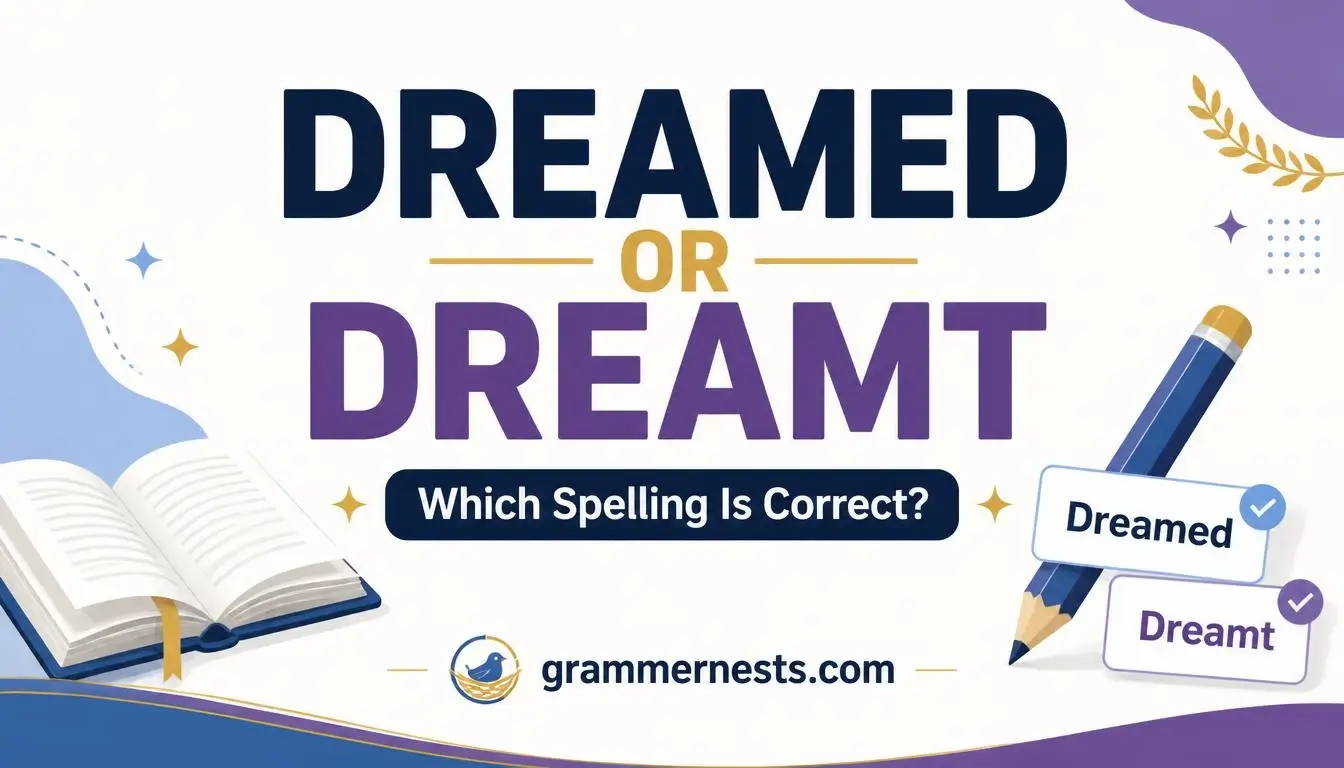
Have you ever wondered if to write dreamed or dreamt? Both spellings appear in books, newspapers, emails, and everyday conversations.
This can make it difficult to know which form is correct, especially when writing for an American or British audience.
The confusion exists because English has two accepted past-tense forms of the verb dream. One ends in -ed, while the other ends in -t. Both forms describe something you experienced while sleeping or something you imagined or hoped for.
Although the two words have the same basic meaning, their popularity differs across English-speaking countries. American writers usually prefer dreamed, while British writers commonly use both dreamed and dreamt.
Understanding the difference can help you avoid spelling mistakes and make your writing sound natural.
If you are preparing a school assignment, writing a professional email, or publishing an online article, knowing when to use each form will make your English clearer and more confident.
Dreamed or Dreamt – Quick Answer
Both dreamed and dreamt are correct spellings. They are the simple past tense and past participle of the verb dream.
The main difference is regional preference:
- Dreamed: More common in American English and widely used in international writing.
- Dreamt: More common in British English than in American English, although both forms are accepted in Britain.
Here are some examples:
- I dreamed about visiting Italy last night.
- I dreamt about visiting Italy last night.
- She has dreamed of becoming a doctor since childhood.
- He had dreamt about that moment for years.
Both forms have the same meaning. Neither is grammatically wrong.
Quick rule: Use dreamed for American audiences. Use either dreamed or dreamt for British audiences. If you are unsure, dreamed is a safe choice.
The Origin of Dreamed and Dreamt
The word dream has a long history in the English language. It comes from the Old English word drēam, which was linked to joy, music, and happiness in its older use.
By the Middle English period, the word had developed the meaning of thoughts and images experienced during sleep. It also became a way to describe hopes, wishes, and things imagined while awake.
The verb dream developed two past-tense forms:
- Dreamed: This follows the regular English rule of adding -ed to a verb.
- Dreamt: This follows an older irregular pattern in which the ending changes to -t.
English has several verbs with similar forms. For example:
- Burn → Burned or burnt
- Learn → Learned or learnt
- Dream → Dreamed or dreamt
- Smell → Smelled or smelt
- Spell → Spelled or spelt
These variations developed through changes in English grammar over time. Both forms became accepted, but their popularity changed across regions.
Today, dreamed is especially common in American English, while dreamt has a stronger association with British English.
The difference is mainly about language preference, not meaning or correctness.
British English vs American English Spelling
British and American English sometimes use different forms of the same verb. The difference between dreamed and dreamt is one example.
In American English, writers usually prefer dreamed. It follows the regular past-tense pattern and is widely accepted in schools, newspapers, business writing, and books.
In British English, both forms are accepted. However, dreamt is more strongly associated with British usage and can sound natural in everyday speech and creative writing.
Here is a simple comparison:
| Language variety | Preferred spelling | Other accepted spelling |
| American English | Dreamed | Dreamt |
| British English | Dreamed / Dreamt | Both accepted |
| Canadian English | Dreamed | Dreamt |
| Australian English | Dreamed / Dreamt | Both accepted |
| International English | Dreamed | Dreamt |
The table shows general preferences, not strict rules. Writers in different countries may use either form.
Examples in American English
- I dreamed about my childhood home.
- She dreamed of becoming a writer.
- We dreamed of starting our own business.
Examples in British English
- I dreamt about my childhood home.
- She dreamt of becoming a writer.
- We dreamt of starting our own business.
All six sentences are correct.
The important point is that American writers generally favor dreamed, while dreamt has a stronger British association.
Which Spelling Should You Use?
Your choice depends on your audience, writing style, and the type of English you want to follow.
1. For American Readers
Use dreamed when writing for people in the United States.
It is the most familiar form in American writing. You can use it in school assignments, business emails, websites, reports, and social media posts.
Example:
“I dreamed about opening my own restaurant.”
2. For British and Commonwealth Readers
You can use either dreamed or dreamt.
British readers are familiar with both forms. However, dreamt may sound more natural in some British conversations and literary writing.
Example:
“I dreamt about our holiday in London.”
3. For International Readers
Use dreamed if you want a simple and widely recognized choice.
It is common in American English and also accepted in British and other English varieties. This makes it a practical option for international websites, educational content, and professional documents.
Example:
“She dreamed of building a better future.”
4. For Academic and Professional Writing
Both forms are correct in formal writing.
However, consistency is important. If you begin a document using dreamed, continue using that form. If you choose dreamt, use it throughout the same document.
Do not switch between the two forms without a reason.
Common Mistakes with Dreamed or Dreamt
Although both spellings are correct, writers sometimes make mistakes when using them.
Here are some common errors and their corrections.
| Incorrect usage | Correct usage | Explanation |
| I dreamt yesterday about school. | I dreamt about school yesterday. | The corrected sentence sounds more natural. |
| She has dreamt of becoming a singer. | She has dreamed of becoming a singer. | Use of before a noun or gerund in this construction. |
| He dreamt about his family. | He dreamt about his family. | Do not add an s to about. |
| I have dreamt yesterday. | I dreamed yesterday. | Use the simple past with a finished time. |
| She dreams last night. | She dreamed last night. | Use a past-tense form for a past event. |
| I have dreamt a beautiful dream yesterday. | I dreamed a beautiful dream yesterday. | Use the simple past with yesterday. |
Mistake 1st: Thinking Dreamt Is Incorrect
Some people believe that dreamt is not a real English word.
This is incorrect. It is a standard past-tense form of dream.
Correct: “I dreamt about my old school.”
Mistake 2nd: Thinking Dreamed Is Only American
Although dreamed is strongly associated with American English, British writers also use it.
Correct: “She dreamed of traveling around the world.”
Mistake 3rd: Mixing Both Forms in One Document
Using both forms in the same article or report can make your writing inconsistent.
For example:
- I dreamed about the ocean.
- Later, I dreamt about a mountain.
Both sentences are correct, but using one form throughout the document is usually better.
Mistake 4th: Confusing Past Tense and Past Participle
Both dreamed and dreamt can be used as past tense and past participle forms.
Examples:
- Simple past: I dreamed about you.
- Present perfect: I have dreamed about you.
- Past perfect: I had dreamt about you.
Remember that the helping verbs has, have, and had can be followed by either accepted form.
Dreamed in Everyday Examples
Both forms can appear in everyday writing. The choice depends on your preferred English style and audience.
Here are examples from different writing situations.
1. In Emails
You can use either form in personal or professional emails.
Using dreamed:
“Hi Sarah,
I dreamed about our last vacation. It reminded me of the wonderful time we spent together.”
Using dreamt:
“Hi James,
I dreamt about the project last night and thought of a few new ideas.”
Both examples are correct and natural.
2. In News Articles
News writers may use either form when reporting someone’s experience, hopes, or plans.
Examples:
- The young athlete dreamed of winning an Olympic medal.
- The singer dreamt of performing on a major stage.
- The company founder dreamed of building a successful business.
For American news publications, dreamed is generally the safer choice.
3. On Social Media
Both spellings work in captions, posts, and personal updates.
Examples:
- I finally achieved what I dreamed of!
- I dreamt about this day for years.
- Never stop chasing what you have dreamed of.
- She dreamed big and worked hard to succeed.
Social media writing is usually informal, so either spelling is acceptable.
4. In Formal Writing
In reports, essays, research papers, and professional documents, both forms are grammatically correct.
Examples:
- The author dreamed of creating a better education system.
- The scientist dreamt of discovering a new solution.
- Many people have dreamed of living in a peaceful world.
For formal writing, follow the spelling style used by your school, publisher, or organization.
Dreamed or Dreamt – Google Trends and Usage Data
People search for dreamed or dreamt because both forms are correct, but they are unsure which one to use.
Regional differences make the question more common among students, bloggers, editors, and English learners.
Which Form Is More Popular?
The general usage pattern is:
- United States: Dreamed is much more common.
- United Kingdom: Dreamed is also widely used, although dreamt has a stronger regional association.
- Canada: Dreamed is a common choice.
- Australia: Both forms are used.
- Other English-speaking regions: Preferences can vary, but dreamed is a widely understood option.
Historical corpus research also shows that dreamed is more frequent than dreamt in both American and British English, although the difference is much greater in American usage.
How to Check Google Trends
Google Trends can help you compare search interest for the phrases dreamed and dreamt.
You can follow these steps:
- Open Google Trends.
- Enter the search term “dreamed.”
- Add “dreamt” as a comparison term.
- Select a country or choose worldwide results.
- Set a time range, such as the past 12 months or five years.
- Compare the interest shown for both terms.
Remember that Google Trends uses an indexed scale from 0 to 100. These numbers represent relative search interest, not exact search volumes.
A score of 100 means the highest relative interest in the selected location and time range.
Why Do People Search for Both Spellings?
There are several reasons:
- They want to know which spelling is grammatically correct.
- They are learning the difference between American and British English.
- They need the correct form for an essay or assignment.
- They want to avoid spelling mistakes in professional writing.
- They see both forms in books, articles, and online posts.
Important: Search popularity and word usage are not the same thing. Google Trends measures interest in search terms, while language corpora such as Google Books Ngram show how words appear in published books.
Dreamed vs Dreamt: Comparison Table
The following table summarizes the main differences between the two spellings.
| Feature | Dreamed | Dreamt |
| Meaning | Past tense of dream | Past tense of dream |
| Grammar | Regular verb form | Irregular verb form |
| Spelling | Dream + ed | Dream + t |
| American English | More common | Less common |
| British English | Common | Also common |
| Past participle | Yes | Yes |
| Formal writing | Correct | Correct |
| Informal writing | Correct | Correct |
| Pronunciation | /driːmd/ | /dremt/ |
| Best general choice | Widely preferred | Regional alternative |
Dreamed vs Dreamt: Example Sentences
| Dreamed | Dreamt |
| I dreamed about my family. | I dreamt about my family. |
| She dreamed of becoming a teacher. | She dreamt of becoming a teacher. |
| We dreamed of a better future. | We dreamt of a better future. |
| He has dreamed of success. | He has dreamt of success. |
| They had dreamed about that trip. | They had dreamt about that trip. |
The meaning stays the same in every pair. You can use either form without changing the message.
FAQs:
Is dreamed or dreamt correct?
Both dreamed and dreamt are correct. They are accepted past-tense and past participle forms of the verb dream. The main difference is regional preference.
Is dreamt a real English word?
Yes. Dreamt is a real and accepted English word. It is the irregular past-tense form of dream. It is commonly associated with British English.
Is dreamed American or British English?
Dreamed is more common in American English, but British writers also use it. It is accepted in both varieties of English.
Is dreamt more British than American?
Yes. Dreamt has a stronger association with British English. However, it is also understood and accepted in American English.
Can I use dreamed in formal writing?
Yes. Dreamed is correct in formal writing, including essays, reports, academic papers, and business documents. It is also a good choice for international audiences.
What is the past participle of dream?
Both dreamed and dreamt are past participles of dream.
Examples:
- I have dreamed about this moment.
- I have dreamt about this moment.
Both sentences are grammatically correct.
Conclusion:
Choosing between dreamed or dreamt is easy once you understand their differences. Both spellings are correct, and both are used as the past tense and past participle of the verb dream. The main difference is regional preference rather than grammar or meaning.
American English generally favors dreamed, while British English uses both forms, with dreamt having a stronger British association. Writers in Canada, Australia, and other English-speaking countries may also use either spelling.
If you are writing for an American audience or an international website, dreamed is a practical choice. If your audience prefers British English, you can use dreamt without worrying about correctness.
The most important rule is to stay consistent. Avoid switching between the two forms in the same article or document without a clear reason. Once you choose a spelling, use it throughout your writing.
Remember, both words are correct. Your audience and writing style should guide your choice.
Read More Posts:
- Is Wellbeing One Word or Two? British and American English Rules
- Skillset or Skill Set in American and British English Guide 2026
- Me Either or Me Neither: Formal and Informal English Usage

Toni Morrison is a celebrated American novelist known for her powerful storytelling, rich characters, and lasting impact on literature. At GrammerNests.com, she shares insights that help readers appreciate language, writing, and literary expression.






2 thoughts on “Is It Dreamed or Dreamt? Learn the Correct Usage Guide 2026”