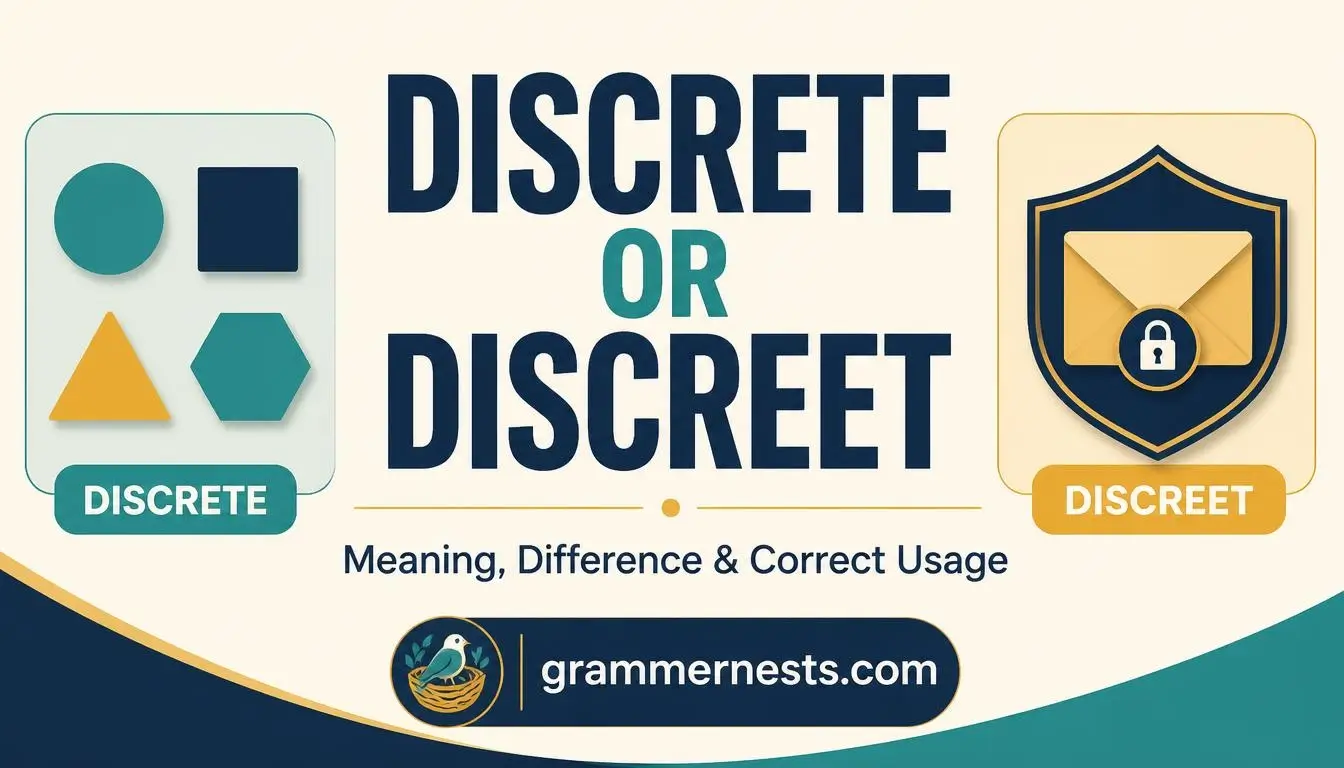
Choosing between discrete or discreet can be confusing because both words sound the same. However, they have very different meanings. One refers to separate or distinct things, while the other describes someone careful, private, or quiet.
For example, you might use discrete when talking about separate groups, data points, or individual steps in a process.
On the other hand, you might use discreet when describing a person who keeps a secret or handles a private matter with care.
This spelling confusion is common in emails, school assignments, business documents, and everyday writing. Since both words have the same pronunciation, it is easy to choose the wrong one without noticing the mistake.
Understanding the difference between these words can help you write more clearly and avoid common grammar errors.
In this guide, next you will learn their meanings, origins, spelling rules, and correct usage, with simple examples to help you remember which word belongs in each sentence.
Discrete or Discreet – Quick Answer
Both discrete and discreet are correct English words, but they have different meanings.
- Discrete: Means separate, distinct, or individually different.
- Discreet: Means careful, private, or not attracting attention.
Here are some simple examples:
| Word | Example | Meaning |
| Discrete | The study has three discrete sections. | Three separate sections |
| Discreet | Please be discreet about this matter. | Keep the matter private |
| Discrete | The data contains five discrete values. | Five distinct values |
| Discreet | She gave me a discreet warning. | A quiet or careful warning |
Easy memory trick:
- Discrete has an extra letter E before the T. Think of separate or distinct elements.
- Discreet has two E’s together at the end. Think of keeping something secret.
Remember: If you mean separate things, use discrete. If you mean privacy or careful behavior, use discreet.
The History of Discrete and Discreet
Although these words have different meanings today, they share a common history.
Both words come from the Latin word discretus, which means separate, distinct, or divided. This Latin word is related to discernere, meaning to separate, distinguish, or recognize differences.
Over time, the two spellings developed different meanings in English.
History of Discrete
The word discrete entered English through Old French and Latin influences. It developed from the idea of separating one thing from another.
Today, it describes things that are separate, individual, or clearly different.
For example:
- The report contains four discrete sections.
- These are two discrete problems.
- The machine records discrete measurements.
In each example, the word describes something that can be considered separately.
History of Discreet
The word discreet also comes from the same Latin root. Its earlier meaning was connected with judgment, wisdom, and the ability to make careful decisions.
Over time, its meaning became associated with being cautious, sensible, and private.
For example:
- He was discreet about the family issue.
- Please make a discreet phone call.
- She handled the situation in a discreet way.
Today, discreet usually describes someone who knows how to act carefully without attracting unwanted attention.
Why Are the Spellings Different?
The two words developed different spellings as their meanings became more specialized.
Although their pronunciation remains the same, their spelling helps readers understand the intended meaning.
This is why discrete and discreet are called homophones. Homophones are words that sound alike but have different spellings and meanings.
British English vs American English Spelling
Unlike some spelling differences between British and American English, discrete and discreet do not change their spelling across these varieties.
Both countries use the same two words with the same meanings.
| Word | American English | British English | Meaning |
| Discrete | Discrete | Discrete | Separate or distinct |
| Discreet | Discreet | Discreet | Careful or private |
Usage in American English
American writers use discrete when discussing separate objects, categories, or values.
Examples:
- The program has three discrete stages.
- Each group works on a discrete project.
They use discreet when discussing privacy or careful behavior.
Examples:
- Please be discreet during the meeting.
- He made a discreet request for help.
Usage in British English
British English follows the same spelling and meaning rules.
Examples:
- The research includes several discrete categories.
- She was discreet when discussing the problem.
There is no standard British spelling such as discreet for separate things or discrete for private behavior.
What About Other English-Speaking Countries?
Countries such as Canada, Australia, and New Zealand also generally follow these spelling rules.
The spelling remains the same in formal, academic, and everyday writing.
The main difference is not regional spelling. It is understanding which meaning you want to express.
Which Spelling Should You Use?
Your choice depends on the meaning of your sentence, not your location.
Whether you write for an American, British, Australian, or international audience, the rules remain the same.
Use Discrete for Separate Things
Choose discrete when you want to describe individual items, separate groups, or distinct parts of something.
Examples:
- The company operates in three discrete markets.
- The experiment uses discrete measurements.
- Each student completed a discrete task.
This word is especially common in mathematics, science, technology, research, and business writing.
Use Discreet for Privacy and Care
Choose discreet when you want to describe someone who behaves carefully or avoids drawing attention.
Examples:
- Please be discreet about the news.
- The manager made a discreet inquiry.
- She is discreet when discussing personal matters.
This word is useful in professional emails, personal conversations, business communication, and formal writing.
Advice for Global Writers
If you write for an international audience, remember these two simple rules:
- Separate or distinct = Discrete.
- Private or careful = Discreet.
You do not need to change either spelling for a different country.
Common Mistakes with Discrete and Discreet
Many writers confuse these words because they sound alike. However, using one in place of the other can change the meaning of a sentence.
Here are some common mistakes and their corrections.
1. Using Discreet Instead of Discrete
Incorrect: The company has five discreet departments.
Correct: The company has five discrete departments.
Why? The sentence describes five separate departments, not departments that keep secrets.
2. Using Discrete Instead of Discreet
Incorrect: Please be discrete about our conversation.
Correct: Please be discreet about our conversation.
Why? The speaker wants someone to keep the conversation private.
3. Confusing Discrete Data with Private Data
Incorrect: The researcher collected discreet data points.
Correct: The researcher collected discrete data points.
Why? Data points that represent separate values are called discrete data points.
4. Using the Wrong Word in Professional Emails
Incorrect: I will be discrete when discussing your personal information.
Correct: I will be discreet when discussing your personal information.
Why? The sentence describes careful and private behavior.
5. Assuming Both Words Have the Same Meaning
Incorrect: The two words can be used interchangeably.
Correct: The two words have different meanings and cannot usually replace each other.
Why? One describes separation, while the other describes privacy or caution.
Remember: The best way to avoid these mistakes is to check the meaning of your sentence before choosing the spelling.
Discrete and Discreet in Everyday Examples
Both words appear in everyday communication, but they are used in different situations.
Let’s look at examples from emails, news, social media, and formal writing.
1. Examples in Emails
In professional emails, discreet is common when discussing private information.
Examples:
- Please be discreet when sharing this information.
- I would appreciate your discreet handling of this matter.
- We need to keep these discussions discreet.
Discrete is useful when explaining separate tasks or project stages.
Examples:
- The project has three discrete parts.
- Each department will handle a discrete responsibility.
2. Examples in News
News articles may use discrete to describe separate events, groups, or categories.
Examples:
- The report identified several discrete areas of concern.
- Researchers studied discrete changes in population growth.
Discreet may describe private discussions or careful actions.
Examples:
- Officials held a discreet meeting.
- The company made a discreet effort to resolve the issue.
3. Examples on Social Media
People may use discreet when talking about private conversations or personal matters.
Examples:
- Please be discreet about what happened yesterday.
- I need a discreet way to ask this question.
Discrete is less common in casual posts but may appear in educational or technical discussions.
Examples:
- These are two discrete ideas.
- The app organizes information into discrete categories.
4. Examples in Formal Writing
Both words are useful in academic and professional documents.
Examples with discrete:
- The research examines three discrete variables.
- The results were divided into discrete categories.
- Each stage represents a discrete part of the process.
Examples with discreet:
- The organization maintains a discreet approach to sensitive matters.
- Employees should remain discreet when handling confidential information.
- The manager requested a discreet investigation.
Discrete or Discreet – Trends and Usage Data
People search for discrete or discreet because both words sound alike and are easy to confuse.
The search usually comes from students, professionals, bloggers, and people who want to improve their spelling and grammar.
Which Word Is More Popular?
Both words are used in modern English, but their popularity depends on the subject.
Discrete appears frequently in:
- Mathematics and statistics
- Computer science
- Scientific research
- Data analysis
- Business reports
Discreet appears frequently in:
- Personal communication
- Professional emails
- Privacy discussions
- Relationships
- Confidential business matters
The words serve different purposes, so their search popularity does not necessarily show that one spelling is more correct than the other.
Popularity by Country
Both spellings are recognized in major English-speaking countries, including:
- United States
- United Kingdom
- Canada
- Australia
- New Zealand
There is no major country-based spelling difference between them.
Discrete vs Discreet: Comparison Table
Here is a quick side-by-side comparison to help you remember the difference.
| Feature | Discrete | Discreet |
| Meaning | Separate or distinct | Careful or private |
| Pronunciation | /dɪˈskriːt/ | /dɪˈskriːt/ |
| Part of speech | Adjective | Adjective |
| Main use | Separate items or groups | Privacy and caution |
| Common context | Math, science, data | Emails, relationships, business |
| Example | Discrete categories | Discreet behavior |
| British spelling | Discrete | Discreet |
| American spelling | Discrete | Discreet |
The main difference: Discrete describes separate things, while discreet describes careful behavior or respect for privacy.
FAQs:
Is it discrete or discreet?
Both spellings are correct, but they have different meanings. Discrete means separate or distinct, while discreet means careful, private, or not attracting attention.
What is the easiest way to remember discrete vs discreet?
Remember that discrete means separate or distinct. You can connect its spelling with the idea of different elements. Discreet means private or careful, so remember it when talking about secrets or sensitive matters.
Are discrete and discreet pronounced the same?
Yes. Both words have the same pronunciation: /dɪˈskriːt/. They are homophones, which means they sound alike but have different spellings and meanings.
Is discreet a compliment?
Yes, discreet can be a compliment. It often describes someone who respects privacy, handles sensitive information carefully, and avoids unnecessary attention.
Example: She is a discreet and trustworthy employee.
What does discrete mean in mathematics?
In mathematics, discrete describes separate and distinct values rather than continuous values.
For example, the number of students in a classroom is discrete because you count whole people rather than fractions of a student.
Is there a difference between British and American spelling?
No. Both British and American English use discrete and discreet with the same spelling and meaning. There is no regional spelling variation.
Can discrete and discreet be used interchangeably?
No. They have different meanings and should not be used interchangeably.
For example:
- Discrete groups = Separate groups.
- Discreet groups = Groups that behave privately or carefully.
Changing the word can change the meaning of your sentence.
Conclusion:
Understanding the difference between discrete or discreet can help you avoid a common English spelling mistake. Although both words sound the same, they have different meanings and uses.
Use discrete when describing separate, individual, or distinct things. It is common in mathematics, science, research, technology, and business writing. For example, you can talk about discrete values, discrete groups, or discrete stages.
Use discreet when describing someone careful, private, or respectful of sensitive information. It is useful when discussing personal matters, professional communication, confidential conversations, and private decisions.
The good news is that neither American nor British English changes these spellings. The correct choice depends entirely on the meaning of your sentence.
A simple way to remember the difference is to connect discrete with separate elements and discreet with keeping something private.
Once you understand this distinction, choosing the right word becomes much easier. Always check the meaning before writing, especially in professional emails and formal documents.
Read More Posts:
- Me Either or Me Neither: Formal and Informal English Usage
- Is It Dreamed or Dreamt? Learn the Correct Usage Guide 2026
- Theater or Theatre: American vs British English Guide

Emily Dickinson is one of America’s most influential poets, recognized for her unique style and thought-provoking poetry. Through GrammerNests.com, she contributes valuable perspectives on language, creativity, and the beauty of written expression.





1 thought on “Discrete or Discreet: British and American English Guide 2026”