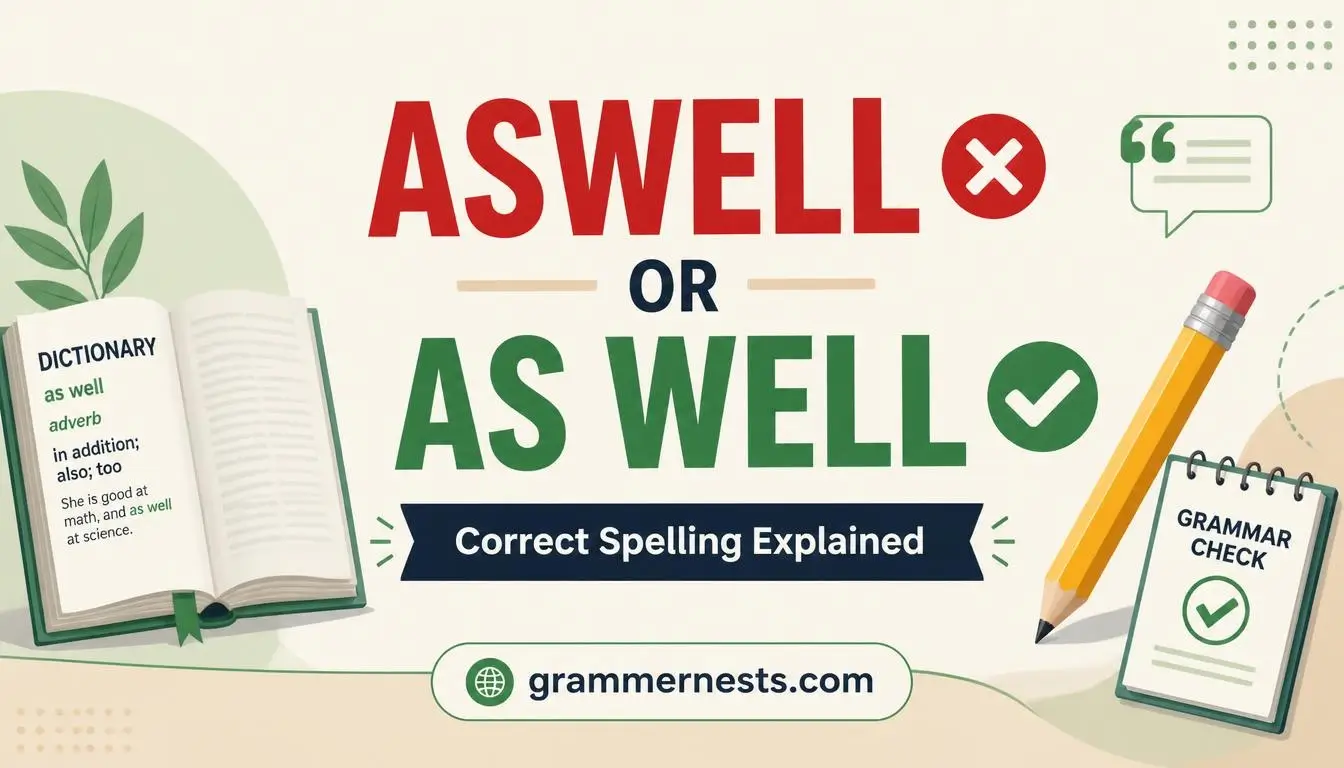
Have you ever wondered whether to write aswell or as well? You are not alone. Many people make this spelling mistake when writing emails, social media posts, school assignments, and professional documents. Both versions look similar, but only one is accepted in standard English.
The confusion happens because English has many compound words. Some words that once appeared separately are now written as one word. For example, anymore, everywhere, and someone are written as single words. This can make people think that “as well” should follow the same pattern.
However, there is a clear spelling rule to remember. The correct form is as well, written as two separate words. It means “also,” “too,” or “in addition.” The one-word spelling “aswell” is a common typing and spelling mistake.
Next, you will learn the difference between aswell and as well, explore their origins, compare British and American English, and see practical examples. You will also learn which spelling to use in formal and informal writing.
Aswell or As Well – Quick Answer
As well is the correct spelling. It is always written as two separate words.
“Aswell” is incorrect in standard English. It does not appear as an accepted spelling in standard American or British English.
The phrase “as well” means:
- Also
- Too
- In addition
- Along with something else
Examples:
- I want to visit London as well.
- She speaks French as well.
- He invited his brother as well.
- You can join us as well.
In each sentence, “as well” adds another person, action, or thing.
Quick comparison:
| Spelling | Correct or Incorrect? | Explanation |
| As well | Correct | Standard English spelling |
| Aswell | Incorrect | Common spelling mistake |
| As well as | Correct | Means in addition to or together with |
| Aswell as | Incorrect | Incorrect spelling |
Remember this simple rule: Always write “as well” as two words, whether you are writing a casual message or a formal document.
The Origin of Aswell or As Well
The phrase “as well” has a long history in the English language. Its spelling and meaning developed from two separate words that work together.
The word “as” has roots in Old English and has been used in English for many centuries. It can express comparison, manner, or degree.
The word “well” also comes from Old English. It originally described something done in a good or proper way. Over time, it developed several meanings and uses.
When these two words came together, “as well” became a phrase used to express addition or similarity. In modern English, it commonly means “also” or “too.”
For example:
- She wants to travel, and I want to travel as well.
- He is a teacher as well as a writer.
Although the two words work together, they have not combined into one standard word.
Why Do People Write Aswell?
There are several reasons why people mistakenly write “aswell.”
- Sound: When people speak quickly, the two words sound like one.
- Typing habits: People sometimes combine words when writing quickly.
- Compound words: English contains many words that have joined together over time.
- Online writing: Informal messages and social media posts can spread spelling mistakes.
However, frequent use does not make an incorrect spelling standard.
British English vs American English Spelling
British and American English have several spelling differences. Words such as “colour” and “color” or “centre” and “center” follow different regional spelling rules.
However, “as well” is not one of those words.
Both British and American English use the same two-word spelling.
British English
In British English, “as well” is written as two separate words. It is commonly used in everyday conversations, professional emails, books, and academic writing.
Examples:
- I would like some tea as well.
- She works in London as well.
- We need to invite Sarah as well.
American English
American English also uses “as well” as two words. The meaning and spelling remain the same.
Examples:
- I want to come as well.
- He bought a new laptop as well.
- We should discuss the other issue as well.
British vs American Spelling Comparison
| Feature | British English | American English |
| Correct spelling | As well | As well |
| One-word form | Aswell (incorrect) | Aswell (incorrect) |
| Meaning | Also or too | Also or too |
| Formal writing | As well | As well |
| Informal writing | As well | As well |
| Pronunciation | Similar | Similar |
There is no regional spelling difference between these two varieties. You should always use “as well” in both.
Which Spelling Should You Use?
The correct choice is simple: use as well in every type of standard English writing.
However, your writing style and audience can affect how you use the phrase.
For American Readers
If you are writing for an American audience, use “as well.” It is a familiar and accepted expression.
Example:
“Our team will review the report as well.”
You can use it in emails, business documents, articles, and everyday messages.
British and Commonwealth Readers
British English, Australian English, Canadian English, and other Commonwealth varieties also use “as well.”
Example:
“I would like to attend the meeting as well.”
There is no need to change the spelling for these audiences.
For a Global Audience
If your readers come from different countries, “as well” is a safe choice.
It is widely understood and works in both formal and informal contexts.
For Professional Writing
Use “as well” in:
- Business emails
- Academic assignments
- News articles
- Reports
- Website content
- Formal letters
Avoid “aswell” because it is not accepted in standard written English.
Common Mistakes with Aswell or As Well
Many writers make small mistakes when using “as well.” Learning these common errors can help you improve your spelling and sentence structure.
1st. Writing Aswell as One Word
This is the most common mistake.
Incorrect:
I want to learn Spanish aswell.
Correct:
I want to learn Spanish as well.
Always leave a space between “as” and “well.”
2nd. Writing Aswell as
Some people also combine the words when using the longer phrase “as well as.”
Incorrect:
She enjoys reading aswell as writing.
Correct:
She enjoys reading as well as writing.
3rd. Confusing As Well with Also
Both expressions can show addition, but their sentence positions can differ.
Examples:
- I also like coffee.
- I like coffee as well.
Both sentences are correct.
4th. Using As Well Too Together
Using “as well” and “too” together can sound repetitive.
Awkward:
I want to come as well too.
Better:
I want to come as well.
Or:
I want to come too.
5th. Forgetting the Space in Formal Documents
A small spelling mistake can make professional writing look less polished.
Always check your emails, reports, and website articles before publishing them.
As Well in Everyday Examples
The phrase “as well” appears in many types of writing. It is useful when you want to add information without repeating an entire sentence.
Here are examples from different situations.
1st. In Emails
“As well” works naturally in professional and personal emails.
Examples:
- Please send me the updated document as well.
- I would like to attend the meeting as well.
- Could you share the final report as well?
- We should invite the marketing team as well.
2nd. In News Articles
News writers use “as well” to add another detail.
Examples:
- The government announced new education plans as well.
- Local businesses will receive support as well.
- The new policy affects students as well.
3rd. On Social Media
The phrase is also common in casual online communication.
Examples:
- I loved the movie as well!
- Happy to see you here as well.
- I want to try that restaurant as well.
- She joined the challenge as well.
4th. In Formal Writing
“As well” can make formal sentences clear and natural.
Examples:
- The research examines social and economic factors as well.
- The report discusses the benefits as well as the risks.
- Students must complete the written assessment as well.
5th. In Everyday Conversations
People use “as well” when agreeing or adding something to a conversation.
Examples:
- A: I enjoy watching football.
- B: I enjoy it as well.
Another example:
- A: We are going to the market.
- B: I will come as well.
Aswell or As Well – Google Trends and Usage Data
People search for “aswell or as well” because they want to know which spelling is correct. The confusion is common among English learners, students, bloggers, and people who write professionally.
The correct phrase, “as well,” is the standard form used in English-speaking countries.
Popularity by Country
The phrase “as well” is commonly used in:
- United States
- United Kingdom
- Canada
- Australia
- New Zealand
- Ireland
- South Africa
- Pakistan
- India
In these countries, standard English follows the same spelling rule.
Search Context
People generally search for this keyword in a few situations:
- Spelling checks: They want to know whether “aswell” is one word.
- Grammar learning: Students want to understand how to use “as well.”
- Professional writing: Workers want to avoid spelling errors in emails and reports.
- Content writing: Bloggers and website owners want to use correct English.
- English learning: Non-native speakers want to improve their writing skills.
What About Google Trends?
Google Trends can help compare search interest for “aswell” and “as well” across countries and over time.
However, search interest is not the same as correct usage. A high number of searches for “aswell” does not mean it is an accepted spelling.
No verified live Google Trends figures are provided here, so exact country rankings and search-volume percentages should not be assumed.
For writers, the important point is that “as well” remains the correct spelling in standard English.
Aswell vs As Well: Comparison Table
The following table makes the difference easy to understand.
| Word or Phrase | Status | Meaning |
| As well | Correct | Also or too |
| Aswell | Incorrect | Common spelling error |
| As well as | Correct | In addition to |
| Aswell as | Incorrect | Incorrect spelling |
| Also | Correct | In addition |
| Too | Correct | Also or in addition |
| Additionally | Correct | Furthermore or in addition |
As Well vs Also vs Too
Although these expressions have similar meanings, they are used in slightly different ways.
As well: Usually appears at the end of a sentence.
Example: I want to visit Paris as well.
Also: Often appears before the main verb or after the verb “be.”
Example: I also want to visit Paris.
Too: Commonly appears at the end of a sentence.
Example: I want to visit Paris too.
All three can express addition. The best choice depends on your sentence and writing style.
FAQs:
Is it aswell or as well?
“As well” is correct. It must be written as two separate words. “Aswell” is a common spelling mistake and is not accepted in standard English.
Is aswell ever correct?
No. “Aswell” is not a standard English word. Use “as well” in formal, academic, professional, and everyday writing.
Is as well one word or two words?
“As well” is always written as two words. The space between “as” and “well” is necessary.
Is as well correct in British English?
Yes. British English uses “as well” as two words. The spelling is the same in American, British, Australian, and Canadian English.
Is as well correct in American English?
Yes. American English also uses “as well.” There is no spelling difference between American and British English for this phrase.
What does as well mean?
“As well” means “also,” “too,” or “in addition.” It adds another person, thing, or action to a sentence.
Example: “My sister wants to come as well.”
What is the difference between as well and as well as?
“As well” usually means “also” or “too.”
Example: I like tea as well.
“As well as” means “in addition to” or “together with.”
Example: She speaks English as well as French.
Both forms are correct, but they have different uses.
Conclusion:
The choice between aswell or as well is simple once you understand the spelling rule. As well is the only correct form in standard English, and it must always be written as two separate words.
The spelling does not change between British and American English, so you can use it confidently with readers around the world.
The phrase means “also,” “too,” or “in addition.” It works well in everyday conversations, social media posts, professional emails, news articles, and academic writing. You can also use the longer expression “as well as” when adding another person, activity, or idea to a sentence.
Remember that “aswell” is a common spelling mistake, not an accepted alternative. If you are unsure, check whether there is a space between the two words. Making this small correction can improve the quality and clarity of your writing.
Whether you are writing a school assignment, business email, or website article, always choose as well for correct and professional English.
Read More Posts:
- Time Flies or Time Flys: Meaning & Grammar Guide
- Thier or Their: Learn the Right Way to Spell It In 2026
- Vender or Vendor: Best Simple Guide to Correct Usage







1 thought on “As Well vs Aswell: Common Errors Guide 2026”