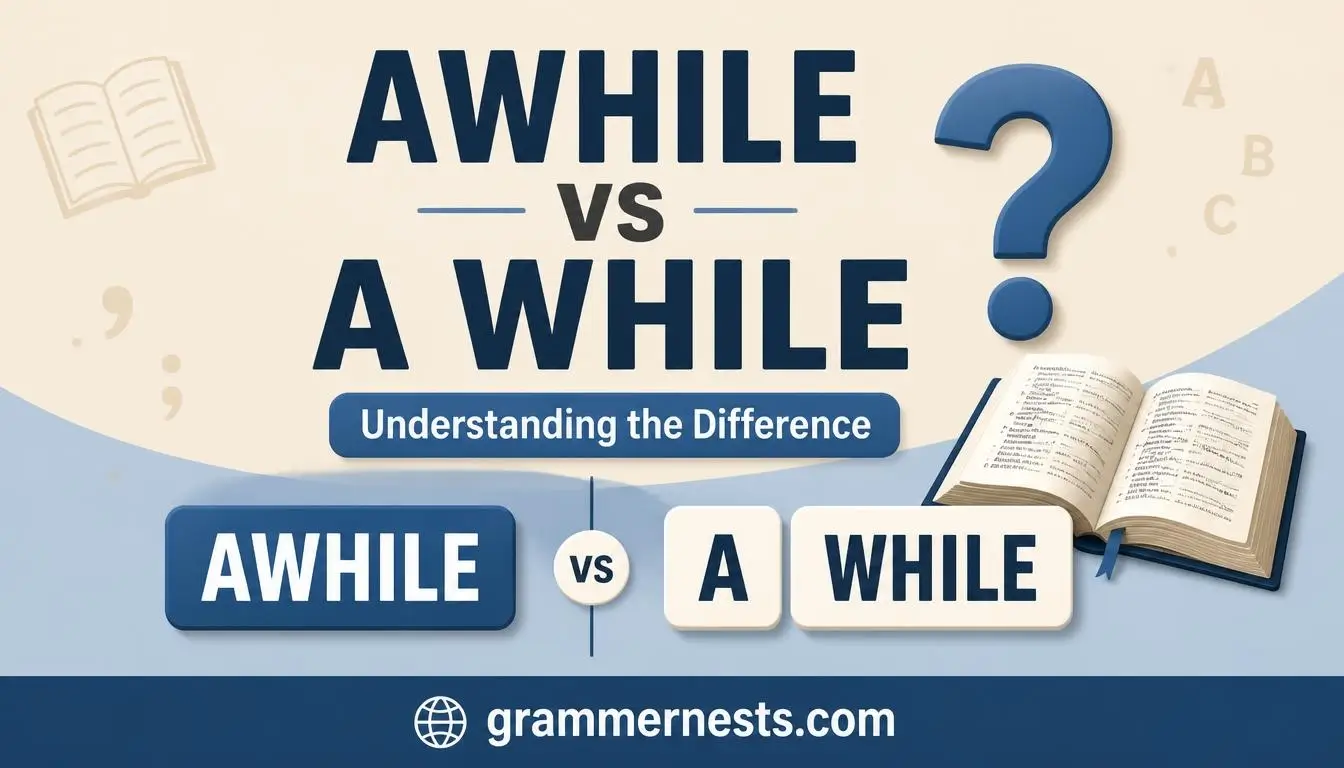
Have you ever wondered whether to write awhile or a while? Both forms look almost the same, and they sound exactly alike when spoken. Yet, they have different grammatical uses. Choosing the wrong form can make your sentence sound awkward or grammatically incorrect.
The confusion usually happens because both expressions refer to a period of time. For example, you might write, “Stay awhile” or “Stay for a while.” Both sentences are correct, but the words work differently.
The main difference is simple: awhile is an adverb, while a while is a noun phrase. The word awhile means “for a short time.” The phrase a while refers to a period of time and can follow a preposition such as “for.”
Understanding this small difference can improve your everyday writing, emails, schoolwork, and professional communication.
In this article, you will learn when to use each form, explore common mistakes, and see simple examples that make the difference easy to remember.
Awhile or A While – Quick Answer
Both awhile and a while are correct English forms. The right choice depends on how you use them in a sentence.
- Awhile: An adverb that means “for a short time.”
- A while: A noun phrase that means “a period of time.”
Consider these examples:
- Please sit awhile.
- Please sit for a while.
Both sentences are correct. In the first sentence, awhile works as an adverb. In the second, a while is a noun phrase that follows the preposition “for.”
Easy Grammar Rule:
If you can replace the word with “for a short time,” use awhile when no additional “for” is needed.
If the sentence already contains “for,” use a while.
| Awhile | A While |
| Stay awhile. | Stay for a while. |
| Wait awhile. | Wait for a while. |
| Rest awhile. | Rest for a while. |
| We talked awhile. | We talked for a while. |
Remember that the meaning is similar, but the grammatical structure is different.
The Evolution of Awhile or A While
The difference between awhile and a while comes from the way English developed over time.
The phrase a while combines two separate words: the article “a” and the noun “while.” The noun while has Old English roots in the word hwil, which referred to a period of time.
Over time, English speakers also began using awhile as a single word. It developed as an adverb with the meaning “for a short time” or “for a period.”
Although the two forms share the same historical roots and meaning, their grammatical roles became different.
Why Do Two Spellings Exist?
English has many expressions that can appear as one word or two words. Their spelling often depends on their grammatical function.
In this case:
- A while names a period of time.
- Awhile describes how long an action happens.
This difference explains why both spellings remain in modern English.
For example:
- She stayed awhile.
- She stayed for a while.
The meaning is nearly identical, but the sentence structure changes.
British English vs American English Spelling
The words awhile and a while are used in both British and American English.
Unlike spelling differences such as “color” and “colour,” this is not a case where one spelling belongs to the United States and another belongs to the United Kingdom.
Both varieties follow the same basic grammar rule.
American English Usage
American English uses awhile as an adverb and a while as a noun phrase.
Examples:
- Please wait awhile.
- I haven’t seen him for a while.
- Let’s talk awhile.
- She lived there for a while.
American writers use both forms in everyday and professional communication.
British English Usage
British English follows the same distinction.
Examples:
- Stay awhile and enjoy the view.
- I haven’t visited them for a while.
- Let’s rest awhile.
- He worked there for a while.
Both forms are also understood in other English-speaking countries, including Canada, Australia, and New Zealand.
British English vs American English Comparison Table
| Grammar Point | American English | British English |
| Adverb form | Awhile | Awhile |
| Noun phrase | A while | A while |
| Stay awhile | Correct | Correct |
| Stay for a while | Correct | Correct |
| Wait awhile | Correct | Correct |
| Wait for a while | Correct | Correct |
Important: There is no major British-versus-American spelling difference here. The grammatical function determines which form you should choose.
Which Spelling Should You Use?
Your choice should depend on the sentence, not the country or audience.
Both forms are accepted in American, British, and international English. However, you should understand their grammatical roles before using them.
For American Readers
If you write for an American audience, use awhile when you need an adverb.
Example: “Please stay awhile.”
Use a while when it follows a preposition or acts as a noun phrase.
Example: “Please stay for a while.”
British and Commonwealth Readers
British, Australian, Canadian, and other Commonwealth readers follow the same rule.
Examples:
- Wait awhile.
- Wait for a while.
Neither form is incorrect in these varieties of English.
For International and Professional Writing
If you write website content, business emails, academic papers, or professional documents, focus on sentence structure.
Choose the form that fits the grammar of your sentence. Avoid replacing every instance of a while with awhile just to make your writing shorter.
Professional advice: When you are unsure, check whether the sentence needs an adverb or a noun phrase. This simple step will help you make the correct choice.
Common Mistakes with Awhile or A While
Even experienced writers sometimes confuse these expressions. The main reason is that they have similar meanings and sound the same.
Here are some common mistakes and their correct forms.
1. Using Awhile After “For”
Incorrect: I will stay for awhile.
Correct: I will stay for a while.
The word “for” is a preposition. It should be followed by the noun phrase a while in this construction.
2. Writing A While as One Word
Incorrect: Please wait a while.
Correct: Please wait awhile.
The first sentence is also grammatically acceptable in standard English. However, awhile is a natural choice when it works as an adverb without a preceding preposition.
The two-word form can also function as an adverbial phrase.
3. Using Awhile in “A While Ago”
Incorrect: I saw her awhile ago.
Correct: I saw her a while ago.
Use two words in expressions such as “a while ago” and “a while back.”
4. Confusing Meaning with Grammar
Incorrect: I haven’t visited my friend for awhile.
Preferred: I haven’t visited my friend for a while.
The phrase “for a while” is the standard construction because it follows the preposition “for.”
5. Thinking One Form Is American and the Other Is British
Incorrect idea: Americans write awhile, while British people write a while.
Correct: Both forms are used in American and British English.
The choice depends on grammar, not regional spelling rules.
Awhile or A While in Everyday Examples
Understanding grammar rules becomes easier when you see how people use these expressions in daily life.
Here are examples from different types of writing.
1. In Emails
Both forms can appear in personal and professional emails.
Examples:
- Please wait awhile while I check the details.
- I have not received your response for a while.
- Let’s discuss this matter again after a while.
- You can take a break and relax awhile.
For professional emails, choose the form that fits the sentence structure.
2. In News Writing
News articles use these expressions when describing time or events.
Examples:
- The team rested a while before the next match.
- The city remained quiet for a while.
- Officials waited awhile before making an announcement.
- The road had been closed for a while.
Both forms help writers describe short or unspecified periods.
3. On Social Media
People commonly use these expressions in captions, comments, and messages.
Examples:
- I need to relax awhile.
- Haven’t seen you in a while!
- Let’s talk for a while.
- Taking a break from social media awhile.
The last example is better written as “Taking a break from social media for a while” or “Taking a break from social media awhile.”
4. In Formal and Academic Writing
Formal writing also uses both forms.
Examples:
- The researchers waited awhile before recording the results.
- The study continued for a while before the final review.
- The organization remained inactive for a while.
- Participants rested awhile before the next activity.
In academic writing, clarity matters more than choosing the shorter form. Use the construction that reads naturally and follows standard grammar.
Awhile or A While – Google Trends & Usage Data
People search for awhile or a while because both forms have similar meanings, but their grammar is different. Students, bloggers, teachers, and English learners commonly look for a simple explanation.
Google Trends can help writers explore interest in these spelling and grammar questions.
Search Interest by Country
The United States, United Kingdom, Canada, and Australia are useful markets to examine when researching this keyword.
However, there is no fixed country-based spelling rule. English speakers in these countries use both forms.
| Country | Common Usage | Grammar Rule |
| United States | Awhile and a while | Same distinction |
| United Kingdom | Awhile and a while | Same distinction |
| Canada | Awhile and a while | Same distinction |
| Australia | Awhile and a while | Same distinction |
| New Zealand | Awhile and a while | Same distinction |
Which Form Is More Common?
The two-word phrase a while appears in many common expressions, including:
- For a while
- A while ago
- After a while
- In a while
- Quite a while
The single-word form awhile is useful when an adverb is needed.
Examples include:
- Stay awhile.
- Rest awhile.
- Wait awhile.
These patterns explain why both forms remain useful in modern English.
How to Check Google Trends Yourself
You can compare the two search terms using Google Trends.
Follow these steps:
- Open Google Trends.
- Enter “awhile” in the search box.
- Add “a while” as a comparison term.
- Select your target country.
- Choose a time range, such as the past 12 months or five years.
- Compare the interest graph and related queries.
SEO tip: Do not claim that one form is more popular in a particular country without checking the actual Google Trends results. Search interest can change over time, and Google Trends reports relative interest rather than exact search volume.
Trends Help
Awhile vs A While – Comparison Table
This table summarizes the main differences between the two forms.
| Feature | Awhile | A While |
| Spelling | One word | Two words |
| Grammar | Adverb | Noun phrase |
| Meaning | For a short time | A period of time |
| Used after “for” | Generally no | Yes |
| Used with “ago” | No | Yes |
| Example | Wait awhile. | Wait for a while. |
| Example | Rest awhile. | Rest after a while. |
| British English | Correct | Correct |
| American English | Correct | Correct |
Remember: Use awhile as an adverb and a while as a noun phrase. This is the easiest way to understand the difference.
FAQs:
Is Awhile or A While Correct?
Both are correct. Awhile is an adverb meaning “for a short time.” A while is a noun phrase meaning “a period of time.” Your sentence determines which form you need.
Is It Wait Awhile or Wait A While?
Both are acceptable.
- Wait awhile.
- Wait a while.
The first uses an adverb. The second uses a noun phrase as an adverbial expression.
Should I Write For Awhile or For A While?
The standard choice is for a while.
Example: “I will stay here for a while.”
The word “for” is followed by the noun phrase “a while.”
Is Awhile One Word or Two Words?
Awhile is one word. A while is two words. Both spellings are correct, but they have different grammatical functions.
Is Awhile American or British English?
Awhile is used in both American and British English. The same is true of a while. Neither form belongs exclusively to one variety of English.
Is It Awhile Ago or A While Ago?
The correct expression is a while ago.
Example: “I visited that place a while ago.”
Do not write “awhile ago” in standard edited English.
What Is the Easiest Way to Remember Awhile vs A While?
Remember this simple rule:
- Use awhile when you need an adverb.
- Use a while after prepositions such as “for” and in expressions such as “a while ago.”
For example, write “Rest awhile” and “Rest for a while.”
Conclusion:
Choosing between awhile or a while becomes easy when you understand their grammatical roles. Both forms are correct, and both refer to a period of time. However, they are not always interchangeable in a sentence.
Use awhile as an adverb when you want to describe an action that continues for a short time. For example, “Please sit awhile.” Use a while when you need a noun phrase, especially after a preposition. For example, “Please sit for a while.”
Remember that American and British English follow the same basic rules. Neither spelling is limited to a particular country. Also, expressions such as “a while ago,” “for a while,” and “after a while” should always use two words.
The best way to avoid mistakes is to understand the sentence before choosing the spelling. With these simple rules and examples, you can use both forms confidently in emails, articles, academic work, and everyday conversations.
Read More Posts:
- Time Frame or Timeframe in Business Writing Guide 2026
- Is Goodmorning One Word or Two? Guide 2026
- Can Onto and On To Be Used Interchangeably? Guide 2026

Emily Dickinson is one of America’s most influential poets, recognized for her unique style and thought-provoking poetry. Through GrammerNests.com, she contributes valuable perspectives on language, creativity, and the beauty of written expression.





2 thoughts on “Awhile or A While: When to Use Each Expression”