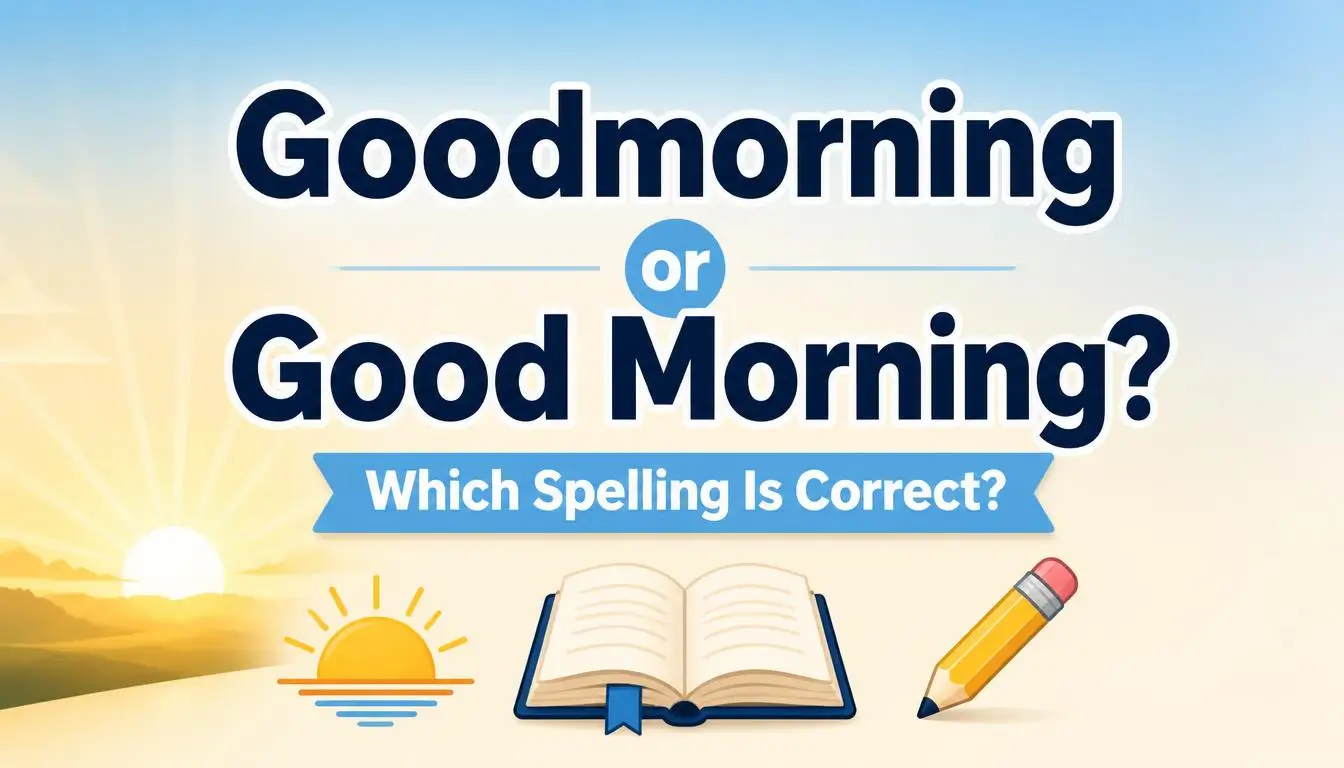
Have you ever wondered if you should write “goodmorning” or “good morning” in a text, email, or greeting card? You are not alone. Many people search for these words because they want to greet someone in the right way. A small space can make a big difference in clear writing.
The correct spelling is “good morning,” written as two separate words. It is a common greeting used when you meet someone in the morning or send a message at the start of the day. You can use it with friends, family, coworkers, teachers, and business contacts.
The confusion often comes from the way people type fast on phones and social media. Some people join the words together and write “goodmorning.”
Others may use it as a hashtag or a username. However, these informal uses do not make it the standard spelling.
In this article, you will learn why “good morning” is correct, where the phrase came from, and how to use it in American and British English. You will also see common mistakes, real-life examples, a comparison table, and answers to popular questions.
Goodmorning or Good Morning – Quick Answer
“Good morning” is the correct spelling. It consists of two words and is used to greet someone in the morning.
“Goodmorning” is not the standard spelling in English. You should avoid it in schoolwork, emails, reports, and other forms of formal writing.
Here are some examples:
- Correct: Good morning, Sarah!
- Correct: Good morning, everyone.
- Incorrect: Goodmorning, Sarah!
- Incorrect: I sent him a goodmorning message.
The phrase can be used at home, at work, in school, or online. It works in both friendly and professional conversations.
For example:
“Good morning, team. Please review the report before our meeting.”
In this sentence, the greeting is polite and clear. The two-word form is correct in both American and British English.
The Origin of Good Morning
The phrase “good morning” comes from two common English words: “good” and “morning.”
The word “good” has roots in Old English gōd. It describes something positive, useful, or pleasant. The word “morning” developed from older English forms related to the early part of the day.
Together, these words became a friendly greeting used when people meet in the morning.
Why Are the Words Written Separately?
English has many phrases made of two separate words. “Good morning” is one of them. Each word keeps its own meaning, and together they express a kind greeting.
Other examples include:
- Good evening
- Good afternoon
- Good night
- Happy birthday
- Thank you
Some English phrases become one word over time. For example, “bedroom” and “notebook” are written as single words. However, “good morning” has kept its standard two-word spelling.
Is Goodmorning Ever Correct?
You may see “goodmorning” in social media usernames, brand names, hashtags, or informal messages. These uses may be intentional, but they do not change the standard spelling.
In normal English writing, use “good morning” as two words.
British English vs American English Spelling
There is no spelling difference between British English and American English when it comes to “good morning.”
Both varieties use the same two-word form. The phrase is widely understood in the United States, the United Kingdom, Canada, Australia, and other English-speaking regions.
| Feature | American English | British English |
| Correct spelling | Good morning | Good morning |
| One-word spelling | Goodmorning (nonstandard) | Goodmorning (nonstandard) |
| Formal emails | Good morning, Mr. Smith. | Good morning, Mr Smith. |
| Friendly greeting | Good morning, Alex! | Good morning, Alex! |
| Capitalization in a sentence | Good morning, everyone. | Good morning, everyone. |
Notice that punctuation may vary slightly by writing style. For example, some British styles omit the full stop after titles such as “Mr,” while American styles commonly use “Mr.”
This difference does not affect the spelling of “good morning.”
Does Capitalization Change the Spelling?
No. Capitalization depends on where the phrase appears.
Use “Good morning” at the start of a sentence:
“Good morning, everyone. Welcome to the meeting.”
Use “good morning” in the middle of a sentence:
“I wished my neighbor good morning.”
In a heading or title, you may capitalize both words according to your chosen style:
“Good Morning: A Simple Guide to the Correct Greeting”
The key rule stays the same: write the phrase as two words.
Which Spelling Should You Use?
The best choice is simple: use “good morning” in all standard English writing, no matter where your readers live.
For American Readers
If you are writing for people in the United States, use “good morning.” It is suitable for school assignments, work emails, text messages, and public announcements.
Example:
“Good morning, everyone. Our meeting will begin at 9 a.m.”
For British and Commonwealth Readers
Readers in the United Kingdom, Canada, Australia, New Zealand, and other Commonwealth countries also use “good morning.”
Example:
“Good morning, Professor Jones. Thank you for your time.”
There is no need to change the spelling to match British English.
Global Readers
If your audience speaks English as a second language, “good morning” is the clearest and safest choice. It is widely recognized and easy to understand.
Use the two-word form in international emails, online articles, business messages, and educational content.
For Text Messages and Social Media
Informal writing allows more freedom, but standard spelling is still useful.
You can write:
“Good morning! Hope you have a great day.”
You may also see hashtags such as #GoodMorning. A hashtag often removes spaces because of how hashtags work. That does not mean the normal phrase should be written as one word.
Common Mistakes with Goodmorning
Many spelling mistakes happen because people type quickly or follow what they see online. Here are the most common errors and how to fix them.
Writing Goodmorning as One Word
Incorrect: “Goodmorning, everyone!”
Correct: “Good morning, everyone!”
Always leave a space between “good” and “morning” in normal writing.
Using Good Morning as One Word in a Sentence
Incorrect: “I sent her a goodmorning text.”
Correct: “I sent her a good morning text.”
The phrase remains two words even when it describes a message or another noun.
Capitalizing Both Words in Every Sentence
Incorrect: “I Said Good Morning To My Teacher.”
Correct: “I said good morning to my teacher.”
In normal sentences, capitalize the first word and proper names. Do not capitalize every word unless a title or a particular style calls for it.
Forgetting the Comma When Addressing Someone
Less clear: “Good morning Sarah.”
Better: “Good morning, Sarah.”
Use a comma before a person’s name when speaking directly to them.
Confusing Good Morning with Goodnight
“Good morning” is used as a greeting at the start of the day. “Good night” is commonly used when leaving someone late in the day or before going to bed.
Examples:
- “Good morning, Dad!”
- “Good night, Dad!”
Both phrases are written as two words in standard usage.
Using Good Morning as a Sign-Off
“Good morning” usually starts a conversation rather than ending one.
Instead of writing:
“Good morning, John. Best regards.”
You could write:
“Good morning, John. I hope you are well. Best regards, Alex.”
The greeting and the sign-off serve different purposes.
Goodmorning in Everyday Examples
The phrase “good morning” appears in many types of writing. Here is how to use it naturally in daily life.
In Emails
A polite greeting helps you begin a professional email.
Example:
“Good morning, Mr. Ahmed,
I am writing to confirm our meeting for tomorrow. Please let me know if the time still works for you.
Kind regards,
Ali”
Use “Good morning” when the greeting suits the time and tone of your message.
In Text Messages
Text messages can be friendly and short.
Examples:
- “Good morning! How did you sleep?”
- “Good morning, Mom. Have a lovely day.”
- “Good morning! Are we still meeting today?”
Even in casual messages, the standard spelling uses two words.
On Social Media
People often share morning greetings, photos, and positive messages online.
Examples:
- “Good morning, friends! Wishing you a happy day.”
- “Good morning! Stay kind and keep smiling.”
- “Good morning, everyone. Enjoy your weekend.”
You may use #GoodMorning as a hashtag, but write “good morning” normally in the caption.
In News and Announcements
Presenters, reporters, and public speakers often use the phrase to welcome an audience.
Examples:
- “Good morning. Here are today’s top stories.”
- “Good morning, viewers. Welcome to our live broadcast.”
- “Good morning, students. The school assembly will begin shortly.”
These examples show how the greeting works in public communication.
In Formal Writing
Formal writing may use “good morning” in letters, invitations, meeting notes, and business communication.
Example:
“Good morning, Members of the Committee,
Thank you for attending today’s meeting. We will begin with a review of the proposed schedule.”
For formal communication, use correct spelling, suitable punctuation, and a tone that fits your audience.
In School Assignments
Students may write the phrase in a short dialogue or a story.
Example:
“Good morning, teacher,” Ali said as he entered the classroom.
The phrase should remain two words in schoolwork.
Goodmorning – Google Trends and Usage Data
People search for “goodmorning or good morning” because they want to know if the phrase should be written as one word or two. Search interest may also come from social media captions, greeting messages, English learning, and professional writing.
However, the popularity of a search term is different from the correctness of its spelling.
Which Countries Use Good Morning?
“Good morning” is widely used in English-speaking countries and in places where English is commonly taught or used for business.
| Country or region | Common use |
| United States | Work greetings, school, texts, and daily conversation. |
| United Kingdom | Everyday greetings and professional communication. |
| Canada | Personal and workplace greetings. |
| Australia | Casual and formal morning greetings. |
| India | English greetings in schools, workplaces, and online messages. |
| Pakistan | English greetings in education, business, and digital communication. |
These examples describe general language use, not measured search rankings.
Is Goodmorning More Popular Online?
The joined form “goodmorning” may appear in usernames, hashtags, captions, and informal posts. People may type it as one word to save space or create a distinctive online label.
That does not prove it is more popular in standard writing.
Google Trends can help compare search interest for “good morning” and “goodmorning” over a selected period and across countries. Its scores are relative to the chosen location and time range, rather than exact search counts.
Without a live comparison, it would be misleading to claim that one spelling has a specific search volume or is the most popular in a particular country.
What Should Writers Learn from Search Trends?
Search trends can reveal what people want to know, but they do not set spelling rules.
For articles, emails, and educational content, use “good morning.”
If you are writing an SEO article targeting the phrase “goodmorning or good morning,” you can include both forms in the title and explain the correct spelling early in the article.
Good Morning vs. Goodmorning: Comparison Table
The following table summarizes the main differences between the two forms and related phrases.
| Phrase | Correct? | Meaning or use |
| Good morning | Yes | Standard morning greeting |
| Goodmorning | No, not in standard prose | Informal joined spelling, username, or hashtag-style form |
| Good Morning | Sometimes | Title-style capitalization or a heading |
| good morning | Yes | Correct lowercase form within a sentence |
| Good morning, John. | Yes | Greeting addressed to a person |
| Good morning everyone. | Needs punctuation improvement | Prefer “Good morning, everyone.” |
| Good night | Yes | Evening farewell or bedtime greeting |
| Good afternoon | Yes | Greeting used in the afternoon |
| Good evening | Yes | Greeting used in the evening |
The safest rule is to write “good morning” as two words. Capitalize the first word at the start of a sentence, and use a comma when directly addressing someone.
FAQs:
Is goodmorning one word or two?
The correct standard spelling is “good morning,” written as two words. “Goodmorning” is nonstandard in ordinary English writing.
Is good morning correct in American English?
Yes. American English uses “good morning” as two words. The spelling is the same in British English.
Should I write Good Morning or good morning?
Use “Good morning” at the beginning of a sentence. Use “good morning” in the middle of a sentence. In titles, capitalization depends on the style you follow.
Can I write goodmorning in a text message?
You may see people use “goodmorning” in informal messages, but “good morning” is still the correct spelling. Use the standard form when you want your message to look clear and polished.
Is Good Morning one word on social media?
No. The normal phrase has two words. However, hashtags such as #GoodMorning usually have no spaces because hashtags do not support spaces within a single tag.
Do British people write good morning differently?
No. British and American English both use “good morning.” Some punctuation and formatting rules differ between the two varieties, but this greeting has the same spelling.
Should I use a comma after good morning?
Use a comma when you address someone directly.
Correct: “Good morning, Sarah.”
You can also use the phrase without a name:
“Good morning! How are you?”
Conclusion:
When choosing between “goodmorning” or “good morning,” the correct choice is clear: write “good morning” as two separate words. This spelling is standard in American English, British English, and other major varieties of English.
The phrase is useful in daily conversations, school assignments, work emails, social media posts, and formal announcements. You can use it to greet friends, welcome a group, or begin a professional message. The main rules are simple: keep the two words separate, capitalize the first word when it begins a sentence, and use a comma when addressing someone by name.
Although “goodmorning” may appear in usernames, hashtags, or casual online writing, it is not the standard spelling for regular sentences. Search trends and social media habits do not change this rule.
If you want your writing to look correct and professional, choose “good morning” every time. This small spelling detail helps make your messages clear, polite, and easy to understand for readers around the world.
Read More Posts:
- Laying vs Lying Down: Simple Grammar Rules
- How to Use Patient and Patience in a Sentence Guide 2026
- Is It Capital or Capitol When Talking About Government?

Emily Dickinson is one of America’s most influential poets, recognized for her unique style and thought-provoking poetry. Through GrammerNests.com, she contributes valuable perspectives on language, creativity, and the beauty of written expression.


2 thoughts on “Is Goodmorning One Word or Two? Guide 2026”