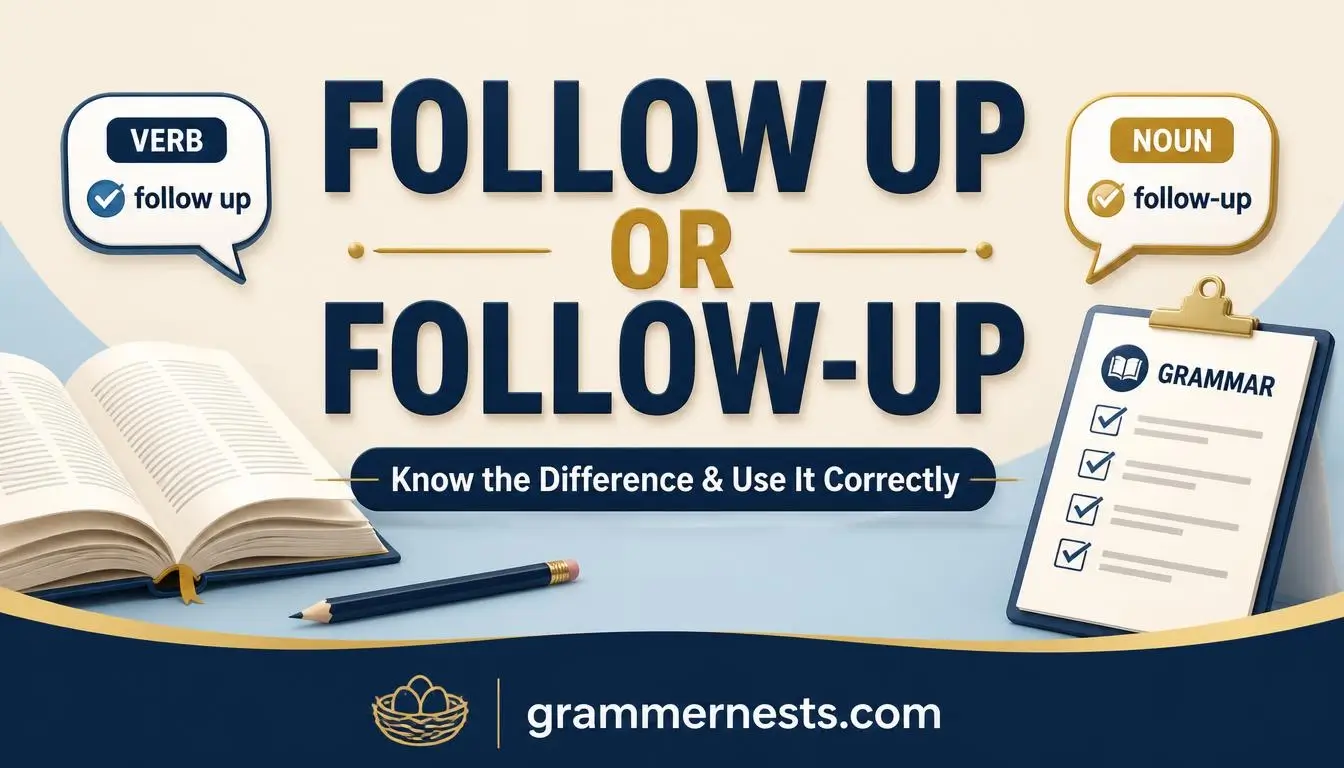
Follow up or Follow-up? These two forms look almost the same, but the small hyphen can change how the words work in a sentence.
Choosing the correct form is important, especially in professional emails, business messages, reports, and formal writing.
The good news is that both forms are correct. Even so, they are not used in the same way. Follow up is usually a verb that describes taking further action or checking on something. Follow-up is a noun or adjective that describes an additional action, meeting, message, or event.
Many writers also wonder whether American and British English follow different spelling rules. In most cases, they use the same forms. The main difference comes from grammar, not geography.
In this guide, you will learn when to use each spelling, understand its origin, explore common mistakes, and see practical examples. By the end, you will know how to choose the right form with confidence.
Follow Up or Follow-Up – Quick Answer
Both follow up and follow-up are correct, but their grammatical roles are different.
- Follow up: Use this two-word form as a verb.
- Follow-up: Use this hyphenated form as a noun or adjective.
- Followup: Avoid this one-word spelling in standard formal English.
Here is a simple way to remember the difference:
| Form | Part of speech | Example |
| Follow up | Verb | I will follow up tomorrow. |
| Follow-up | Noun | We had a follow-up after the meeting. |
| Follow-up | Adjective | She sent a follow-up email. |
| Followup | Incorrect in standard usage | I sent a followup email. |
When to Use Follow Up
Use follow up when someone takes another action, checks on progress, or continues something.
Examples:
- I will follow up with the manager next week.
- Please follow up on your job application.
- The doctor will follow up after your treatment.
- We need to follow up with the customer.
When to Use Follow-Up
Use follow-up when you refer to an additional action or describe something that comes after an earlier event.
Examples:
- I received a follow-up email.
- The patient needs a follow-up appointment.
- We scheduled a follow-up meeting.
- The journalist published a follow-up story.
Easy rule: If you are describing an action, write follow up. If you are naming or describing something, write follow-up.
The Origin of Follow Up and Follow-Up
The expression follow up comes from the verb follow and the adverb up. Together, these words describe continuing an action, checking on something, or taking another step after an earlier event.
The verb follow has Old English roots. It developed from the Old English word folgian, which meant to accompany, move behind, or pursue someone or something.
The word up has Germanic roots and has long been used to describe movement toward a higher point or the completion of an action.
When these words came together, they developed the meaning of continuing an activity or taking further action.
According to the Online Etymology Dictionary, the verbal expression follow up was recorded around 1794. Its noun form, follow-up, appeared around 1905, first in business and sales language.
The hyphen became useful because it helped show that the expression was working as a single grammatical unit rather than as a verb phrase.
Over time, the expression became common in many areas, including:
- Business communication
- Medical care
- Journalism
- Education
- Customer service
- Job applications
Today, both forms are widely accepted in English. Their spelling depends mainly on how they function in a sentence, rather than where the writer lives.
British English vs American English Spelling
One common question is whether British and American English use different spellings of follow up and follow-up.
The answer is no. Both English varieties generally follow the same grammatical rule.
In American English, writers use follow up as a verb and follow-up as a noun or adjective.
British English follows the same pattern.
Follow Up in American English
American writers use the two-word form when describing an action.
Examples:
- I will follow up with you tomorrow.
- Please follow up on the report.
- The manager needs to follow up with the client.
They use the hyphenated form as a noun or adjective.
Examples:
- We arranged a follow-up meeting.
- She received a follow-up call.
- The doctor scheduled a follow-up visit.
Follow Up in British English
British writers also use follow up as a verb and follow-up as a noun or adjective.
Examples:
- I will follow up with the customer next week.
- The school arranged a follow-up meeting.
- He received a follow-up letter.
There is no major spelling difference between the two varieties.
British vs American Comparison Table
| Usage | American English | British English |
| Verb | Follow up | Follow up |
| Noun | Follow-up | Follow-up |
| Adjective | Follow-up | Follow-up |
| Followup | Avoid | Avoid |
| Follow-up email | Correct | Correct |
| Follow up tomorrow | Correct | Correct |
The same general rule also applies to Canadian and Australian English.
The Government of Canada’s Language Portal, for example, advises writers not to hyphenate the phrasal verb follow up. This supports the distinction between the verb and its noun or adjective forms.
Key point: Do not choose the spelling based on American or British English. Choose it based on the grammatical role of the words.
Which Spelling Should You Use?
The right spelling depends on how you use the expression. Your audience can also influence your choice of writing style, but it does not change the basic grammar rule.
Here is some practical advice for different audiences.
1. For American Readers
If you write for an American audience, follow the standard American grammar rule.
Use follow up as a verb.
Examples:
- I will follow up with the hiring manager.
- Please follow up on the payment.
Use follow-up as a noun or adjective.
Examples:
- We need a follow-up meeting.
- I sent a follow-up message.
2. For British and Commonwealth Readers
If your readers are in the United Kingdom, Australia, Canada, or other Commonwealth countries, you can use the same spelling pattern.
Examples:
- I will follow up after the interview.
- She arranged a follow-up appointment.
- We received a follow-up report.
You do not need to change the hyphen based on your readers’ location.
3. For Global Audiences
For international websites, business documents, and online communication, consistency is important.
Use these simple guidelines:
- Write follow up when it acts as a verb.
- Write follow-up when it acts as a noun.
- Write follow-up before another noun as an adjective.
- Avoid followup in standard professional writing.
These rules work well for readers across different English-speaking countries.
Common Mistakes with Follow Up and Follow-Up
Even experienced writers sometimes confuse these forms. The most common problem is using the hyphen in the wrong place.
Here are some mistakes to avoid.
1. Using Follow-Up as a Verb
Incorrect: I will follow-up with you tomorrow.
Correct: I will follow up with you tomorrow.
Why? The expression describes an action, so it should not have a hyphen.
2. Writing Follow Up as an Adjective
Incorrect: I received a follow up email.
Correct: I received a follow-up email.
Why? The expression describes the type of email. It works as an adjective, so the hyphen is needed.
3. Writing Followup as One Word
Incorrect: She sent me a followup message.
Correct: She sent me a follow-up message.
Why? The standard spelling uses a hyphen when the expression functions as a noun or adjective.
4. Using the Wrong Form in Business Emails
Incorrect: I will send a follow up tomorrow.
Correct: I will send a follow-up tomorrow.
Why? Here, a follow-up is a noun. It refers to another message or action.
5. Confusing Follow Up With Follow Through
These expressions have related but different meanings.
- Follow up: Take another action or check on something.
- Follow through: Complete a promise, plan, or action.
Examples:
- I will follow up on your request.
- You must follow through with your promise.
Knowing this difference can make your writing clearer.
6. Adding an Unnecessary Hyphen
Incorrect: We need to follow-up on the complaint.
Correct: We need to follow up on the complaint.
Why? The expression is a verb phrase, so it should remain two separate words.
Follow Up or Follow-Up in Everyday Examples
Understanding the rule becomes easier when you see how people use these forms in daily communication.
Both forms appear in emails, news articles, social media posts, business documents, and professional conversations.
1. Follow Up or Follow-Up in Emails
Emails are one of the most common places where people use these expressions.
Use follow up when you describe what you plan to do.
Examples:
- I wanted to follow up on my previous email.
- I will follow up with you about the meeting.
- Please follow up once you receive the documents.
Use follow-up when referring to another email or communication.
Examples:
- Thank you for your follow-up email.
- I am sending a follow-up message about the application.
- We have scheduled a follow-up call for Monday.
2. Follow Up or Follow-Up in News Writing
Journalists use both forms when reporting on developing stories.
Examples:
- Police will follow up on the latest evidence.
- The newspaper published a follow-up report.
- Reporters plan to follow up with local officials.
- The follow-up article provided new information.
A follow-up story usually adds information to a previously published report.
3. Follow Up or Follow-Up on Social Media
People also use these expressions in social media posts, comments, and messages.
Examples:
- I will follow up with you in my inbox.
- Just checking in with a quick follow-up.
- Don’t forget to follow up on your application.
- Here is a follow-up post with more details.
In casual messages, some people may ignore the hyphen. However, using the standard form helps keep your writing clear.
4. Follow Up or Follow-Up in Formal Writing
Formal writing requires correct grammar and consistent spelling.
Examples:
- The research team will follow up with participants.
- A follow-up study will examine the results.
- The department plans to follow up on the recommendations.
- The report includes a follow-up assessment.
In academic and professional writing, always consider whether the expression is a verb, noun, or adjective.
5. Follow Up or Follow-Up in Medical Writing
Medical professionals use these forms when discussing patient care.
Examples:
- The doctor will follow up with the patient.
- The patient needs a follow-up appointment.
- The hospital arranged a follow-up examination.
- Nurses will follow up on the patient’s recovery.
These examples show how the same expression works in different grammatical roles.
Follow Up or Follow-Up – Trends and Usage Data
People search for both follow up and follow-up because they want to understand the correct spelling, grammar, and meaning.
Google Trends can help writers understand how interest in these search terms changes over time and across countries.
However, it is important to understand what the tool measures.
Google Trends displays relative search interest on a scale from 0 to 100. It does not provide exact monthly search volumes. A score of 100 represents the highest interest within the selected comparison, location, and time period.
Which Form Is More Popular?
The search terms follow up and follow-up can attract different types of searches.
- Follow up: May attract searches related to the verb, including email follow-ups, job applications, and checking on requests.
- Follow-up: May attract searches about hyphenation, grammar, spelling, and noun or adjective usage.
Search results can also depend on how Google groups related terms and interprets user intent.
For a reliable comparison, enter both terms into Google Trends and select the same time range and location.
Popularity by Country
You can compare these terms in different English-speaking countries.
| Country | What to examine |
| United States | Business emails, grammar, and professional communication. |
| United Kingdom | British English grammar and writing conventions. |
| Canada | Canadian English spelling and usage. |
| Australia | Professional communication and grammar. |
| India | English learning and workplace writing. |
These are useful research areas, not verified country rankings. Actual interest can change depending on the selected period and search category.
How to Check Google Trends
Follow these steps:
- Open Google Trends.
- Enter follow up as your first search term.
- Add follow-up as a comparison term.
- Select your preferred country or worldwide results.
- Choose a time range, such as the past 12 months or five years.
- Compare interest over time and by region.
You can also explore related queries to discover what people want to know about these expressions.
Follow Up vs Follow-Up: Comparison Table
Here is a simple comparison of the different forms and their correct uses.
| Word or phrase | Correct or incorrect? | Usage | Example |
| Follow up | Correct | Verb | I will follow up soon. |
| Follow-up | Correct | Noun | We had a follow-up. |
| Follow-up | Correct | Adjective | Send a follow-up email. |
| Followup | Not standard | Avoid | A followup call. |
| Followed up | Correct | Past-tense verb | She followed up yesterday. |
| Following up | Correct | -ing verb form | I am following up now. |
| Follow-ups | Correct | Plural noun | We completed three follow-ups. |
Remember that the hyphenated form can also take different endings when used as a noun or part of a verb phrase.
For example:
- She completed two follow-ups.
- He followed up with the team.
- We are following up on the request.
FAQs:
Is it follow up or follow-up?
Both are correct, but they have different grammatical uses. Write follow up as a verb and follow-up as a noun or adjective.
Examples:
- I will follow up tomorrow.
- I sent a follow-up email.
Is follow-up one word or two words?
The standard form is two words with a hyphen when used as a noun or adjective. As a verb, it is written as two separate words without a hyphen.
The one-word form followup is generally not accepted in standard professional English.
Is follow-up hyphenated in American English?
Yes. American English uses a hyphen when the expression works as a noun or adjective.
Examples:
- A follow-up appointment.
- A follow-up report.
- We need a follow-up.
However, the verb form does not take a hyphen.
Is follow up hyphenated in British English?
No. British English generally follows the same rule as American English.
Use follow up as a verb and follow-up as a noun or adjective.
Example:
- I will follow up with the manager.
- The manager arranged a follow-up meeting.
Is it follow-up email or follow up email?
The correct form is follow-up email.
The expression describes the type of email, so it works as an adjective.
Example: I received a follow-up email from the company.
Is it follow up on or follow-up on?
Use follow up on when describing an action.
Example: I will follow up on your request tomorrow.
Here, follow up is a verb phrase, and on introduces the subject of the action.
What is the plural of follow-up?
The plural noun is follow-ups.
Examples:
- We scheduled three follow-ups.
- The company sent several follow-ups to its customers.
- All follow-ups must be completed by Friday.
Conclusion:
Choosing between follow up or follow-up becomes easy when you understand the difference between their grammatical roles. Both forms are correct, but they do not mean the same thing in a sentence.
Use follow up when describing an action, such as checking on a request, contacting someone again, or continuing an earlier activity. Use follow-up when referring to an additional action or describing something that comes after an earlier event. For example, write “I will follow up tomorrow” but “I will send a follow-up email.”
American and British English follow the same general spelling rules, so you do not need to change the hyphen based on your audience. Also, avoid writing follow-up as one word in standard professional writing.
Whether you are writing an email, preparing a report, creating website content, or communicating with customers, using the correct form makes your writing more professional and easier to understand. Remember the simple rule: verbs have no hyphen, while nouns and adjectives use one.
Read More Posts:
- Take Effect or Take Affect: Meaning & Difference With Examples
- Examples of Drier and Dryer in Daily Writing Guide 2026
- Labelled or Labeled in British & American English 2026 Guide

Emily Dickinson is one of America’s most influential poets, recognized for her unique style and thought-provoking poetry. Through GrammerNests.com, she contributes valuable perspectives on language, creativity, and the beauty of written expression.







2 thoughts on “Follow Up or Follow-Up: Verb, Noun, and Adjective”