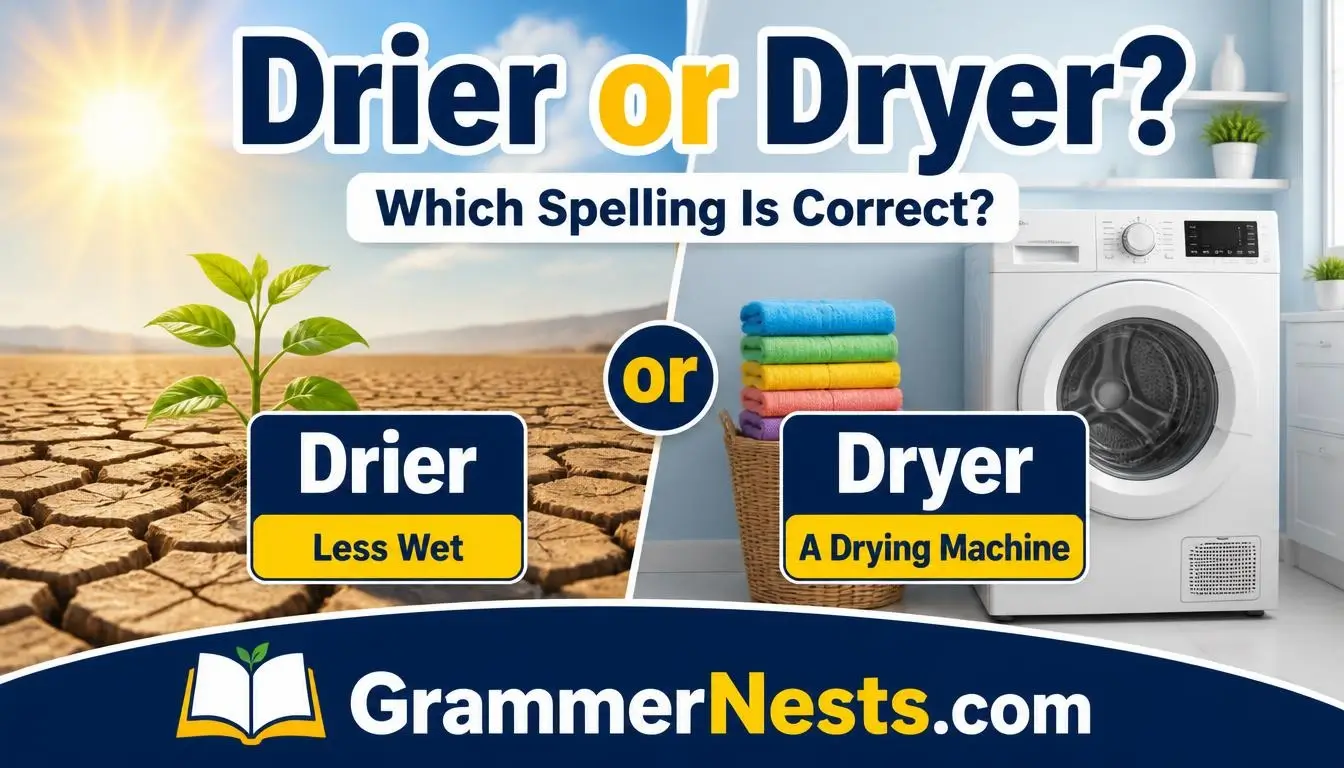
Have you ever stopped while writing to decide between drier or dryer? These two words look almost the same and sound very similar. However, they have different meanings and uses. Choosing the right spelling can make your writing clearer and more professional.
The confusion usually comes from the word dry. When you want to describe something with less moisture, you may need the word drier.
When you talk about a machine that removes water from clothes, you need dryer. Both spellings are correct, but they cannot always replace each other.
People often search for this spelling difference when writing emails, school assignments, product descriptions, or everyday messages. The good news is that the rule is simple once you understand the purpose of each word.
Next,in this you will learn the meaning of drier and dryer, their origins, spelling rules, and differences in British and American English.
You will also find useful examples, common mistakes, and answers to frequently asked questions.
Drier or Dryer – Quick Answer
Both drier and dryer are correct English words, but they have different meanings.
- Drier: The comparative form of the adjective dry. It means less wet or less moist.
- Dryer: A machine or device that removes moisture from something.
Examples:
- The weather is getting drier this week.
- My clothes need to go in the dryer.
- This towel feels drier than the other one.
- We bought a new hair dryer yesterday.
Easy rule to remember: Use drier when comparing dryness. Use dryer when talking about a machine that dries something.
The Origin of Drier and Dryer
The words drier and dryer both come from the English word dry. However, they developed different uses over time.
The word dry has Old English roots. It comes from the Old English word dryge, which described something without moisture or water.
As English developed, people began using different forms of the word to describe objects, conditions, and actions.
How Did Drier Develop?
The word drier comes from the adjective dry.
In English, we usually add -er to an adjective to make its comparative form. A comparative word helps us compare two things.
For example:
- Tall becomes taller.
- Small becomes smaller.
- Cold becomes colder.
- Dry becomes drier.
The spelling changes because the final y changes to i before adding -er.
Therefore, drier means less wet or less moist than something else.
How Did Dryer Develop?
The word dryer is formed from the verb dry and the suffix -er.
The suffix -er can describe a person or thing that acts.
For example:
- Teach becomes teacher.
- Work becomes worker.
- Print becomes printer.
- Dry becomes dryer.
A dryer is something that makes another object dry. It can refer to a clothes dryer, hair dryer, or another drying device.
Although both words come from the same root, their meanings are different.
British English vs American English Spelling
There is no major spelling difference between British and American English when it comes to drier and dryer.
Both forms are accepted in the United States, the United Kingdom, Canada, Australia, and other English-speaking countries.
The difference is based on meaning, not regional spelling rules.
| Word | American English | British English | Meaning |
| Drier | Drier | Drier | Less wet |
| Dryer | Dryer | Dryer | A drying machine |
| Dry | Dry | Dry | Without moisture |
| Drying | Drying | Drying | Removing moisture |
Examples in American English
- The climate is becoming drier.
- I need a new clothes dryer.
- My hair feels drier after washing.
Examples in British English
- The soil is getting drier.
- The tumble dryer is in the kitchen.
- This room is drier than the other one.
British speakers commonly use the term tumble dryer for a clothes-drying machine. American speakers usually say clothes dryer or simply dryer.
However, the spelling remains the same.
Which Spelling Should You Use?
Choosing between drier and dryer depends on what you want to say. Your country does not change the basic spelling rule.
Use Drier When You Mean Less Wet
Choose drier when comparing the moisture levels of two things or describing something that has become less wet.
Examples:
- The air is drier in winter.
- My skin feels drier today.
- This paint needs a drier place to dry.
- The ground is drier than it was yesterday.
Use Dryer When You Mean a Machine
Choose dryer when referring to a device that removes water or moisture.
Examples:
- I put my clothes in the dryer.
- Her new hair dryer works well.
- The dryer stopped working last night.
- We need a faster clothes dryer.
Advice for Global Writers
If you write for an international audience, follow these simple tips:
- United States: Use both spellings according to their meanings.
- United Kingdom: Use both spellings according to their meanings. Tumble dryer is common for laundry appliances.
- Canada and Australia: Both spellings are also standard.
- Global websites: Use the correct word and explain its meaning when needed.
You do not need to change drier to dryer for an American or British audience. The distinction stays the same.
Common Mistakes with Drier and Dryer
Many writers confuse these words because they look and sound similar. Understanding their roles can help you avoid common spelling errors.
1. Using Dryer as a Comparative Adjective
Incorrect: The weather is getting dryer.
Correct: The weather is getting drier.
Why? You are comparing the weather’s moisture level. The correct comparative form of dry is drier.
2. Using Drier for a Machine
Incorrect: I bought a new clothes drier.
Correct: I bought a new clothes dryer.
Why? A machine that removes moisture is called a dryer.
3. Thinking One Spelling Is British and the Other Is American
Incorrect: Drier is British English, while dryer is American English.
Correct: Both words are used in British and American English.
Why? The spelling difference comes from meaning, not location.
4. Confusing Drier with Drying
Incorrect: The clothes are drier in the machine.
Correct: The clothes are drying in the machine.
Why? Drying describes the action of removing moisture. Drier compares how dry something is.
5. Using Dryer When Comparing Two Objects
Incorrect: This towel is dryer than that one.
Correct: This towel is drier than that one.
Why? When comparing two things, use the comparative adjective drier.
Drier or Dryer in Everyday Examples
These words appear in daily conversations, emails, news reports, product descriptions, and formal writing.
Here are examples that show how to use them correctly.
1st. In Emails
Professional emails need clear and correct spelling.
Examples:
- The storage room is drier after the repair.
- Please check whether the clothes dryer is working.
- We need a drier space to store these materials.
2nd. In News Articles
News writers use drier when discussing weather, climate, and environmental conditions.
Examples:
- Several areas are experiencing drier weather this month.
- Experts have warned about drier conditions in the coming weeks.
- The region is facing a longer and drier season.
3rd. On Social Media
People use both words in everyday posts and comments.
Examples:
- My hair feels drier after using this shampoo.
- Finally bought a new dryer!
- The weather is getting drier every day.
4th. In Formal Writing
In academic and professional writing, the correct word depends on the subject.
Examples:
- The study found that drier soil conditions affected plant growth.
- The company introduced a new energy-efficient dryer.
- Drier air can affect the moisture level of certain materials.
5th. In Product Descriptions
Product descriptions commonly use dryer when discussing appliances.
Examples:
- This hair dryer offers several heat settings.
- The new clothes dryer uses less energy.
- The compact dryer is suitable for small homes.
These examples show that context is the best way to choose the correct spelling.
Drier or Dryer – Trends and Usage Data
People search for both drier and dryer because the words look similar but have different meanings.
The search interest for each term can depend on the topic, country, and time of year.
For example, someone searching for dryer may want to buy a laundry appliance, compare hair dryers, or fix a household machine.
On the other hand, someone searching for drier may be looking for the correct comparative form of dry, weather information, or help with English spelling.
Popularity by Country
Search behavior can vary across English-speaking countries.
- United States: Searches for dryer may be connected to clothes dryers, hair dryers, and household appliances.
- United Kingdom: Searches for dryer may relate to tumble dryers and appliance information.
- Canada: Both words appear in searches about weather, appliances, and English grammar.
- Australia: Searches can relate to dry weather, laundry appliances, and spelling questions.
- Other countries: English learners may search for the difference between the two words.
Which Word Is More Popular?
The word dryer may attract more commercial searches because it is widely used as the name of a household appliance. The word drier is more closely connected to comparisons and descriptions.
However, this does not mean one spelling is more correct than the other.
Google Trends can help compare search interest by country, date, and topic. It reports relative interest rather than exact search volume. A higher Trends score does not automatically mean a word has more monthly searches.
You can compare both terms using Google Trends.
Drier vs Dryer – Comparison Table
The following table makes the difference easy to understand.
| Feature | Drier | Dryer |
| Part of speech | Adjective | Noun |
| Root word | Dry | Dry |
| Formation | Dry + er (comparative spelling) | Dry + er (agent/device suffix) |
| Main meaning | Less wet | A drying machine |
| Common use | Weather, skin, soil, clothes | Hair and clothes appliances |
| Example | The air is drier today. | The dryer is broken. |
| British spelling | Drier | Dryer |
| American spelling | Drier | Dryer |
Quick Memory Trick
Remember these two simple sentences:
- Drier = Less wet.
- Dryer = A machine that dries.
If you are comparing two things, choose drier. If you are naming an appliance, choose dryer.
FAQs:
Is it drier or dryer?
Both spellings are correct, but they have different meanings. Drier means less wet or less moist, while dryer refers to a machine that removes moisture.
Is drier the correct spelling of dry?
Yes. Drier is the correct comparative form of the adjective dry. For example, you can say, “The air is drier today.”
Is a clothes drier or dryer?
The correct spelling is clothes dryer. It is a machine that removes moisture from clothes after washing.
Is it hair drier or hair dryer?
The standard spelling is hair dryer. It is an electrical device used to dry wet hair.
Is drier British or American English?
Drier is used in both British and American English. It is not a regional spelling. It is the comparative form of dry.
Why does drier have an i instead of a y?
The final y in dry changes to i when the comparative suffix -er is added. This spelling rule also appears in words such as happy and happier.
Can dryer describe something with less moisture?
In standard everyday English, drier is the preferred comparative adjective. Use dryer for a machine or device that removes moisture.
Conclusion:
Choosing between drier and dryer is simple once you understand their meanings. Both are correct English words, but they serve different purposes. The word drier is the comparative form of dry. It describes something that has less moisture than another thing. For example, you can say, “The air is drier today.”
On the other hand, dryer is a noun that refers to a machine or device used to remove moisture. A clothes dryer and a hair dryer are common examples.
Remember that these spellings do not change between British and American English. Both countries use drier for comparisons and dryer for appliances.
When writing emails, articles, school assignments, or social media posts, think about the meaning before choosing a spelling. If you are comparing two things, use drier. If you are talking about a drying machine, use dryer.
Learning this small difference can make your writing more accurate, natural, and professional.
Read More Posts:
- Ax or Axe: Which Spelling Is Correct in American & British English?
- Aluminum or Aluminium: Which Spelling Is Correct?
- Further or Farther: What Is the Difference?

Toni Morrison is a celebrated American novelist known for her powerful storytelling, rich characters, and lasting impact on literature. At GrammerNests.com, she shares insights that help readers appreciate language, writing, and literary expression.







2 thoughts on “Examples of Drier and Dryer in Daily Writing Guide 2026”