Text a friend something playful, get back a quick “YM,” and you might find yourself staring at the screen trying to piece together what just happened.
This short two-letter abbreviation has become a fixture in casual texting and social media banter, but its meaning isn’t always obvious at first glance, especially since it can shift depending on tone, platform, and who’s texting whom.
People search for its definition because the same letters show up in joking comebacks, genuine questions, nostalgic references to old messaging apps, and even technical fields that have nothing to do with texting at all.
This guide covers every common meaning, explains how it’s used across chat apps and social platforms, and breaks down how this abbreviation compares to similar slang so you’re never left guessing again.
Meaning & Definition
The most common meaning of this abbreviation in modern texting is “Your Mom,” typically used as a playful, joking comeback in casual conversations between friends. It often follows a lighthearted insult or joke, mimicking the classic “yo mama” joke format in a much shorter form.
Common meaning, especially in conversational back-and-forth, is “You Mean,” used when someone wants clarification about what another person just said. In this sense, it functions more like a question starter than a joke.
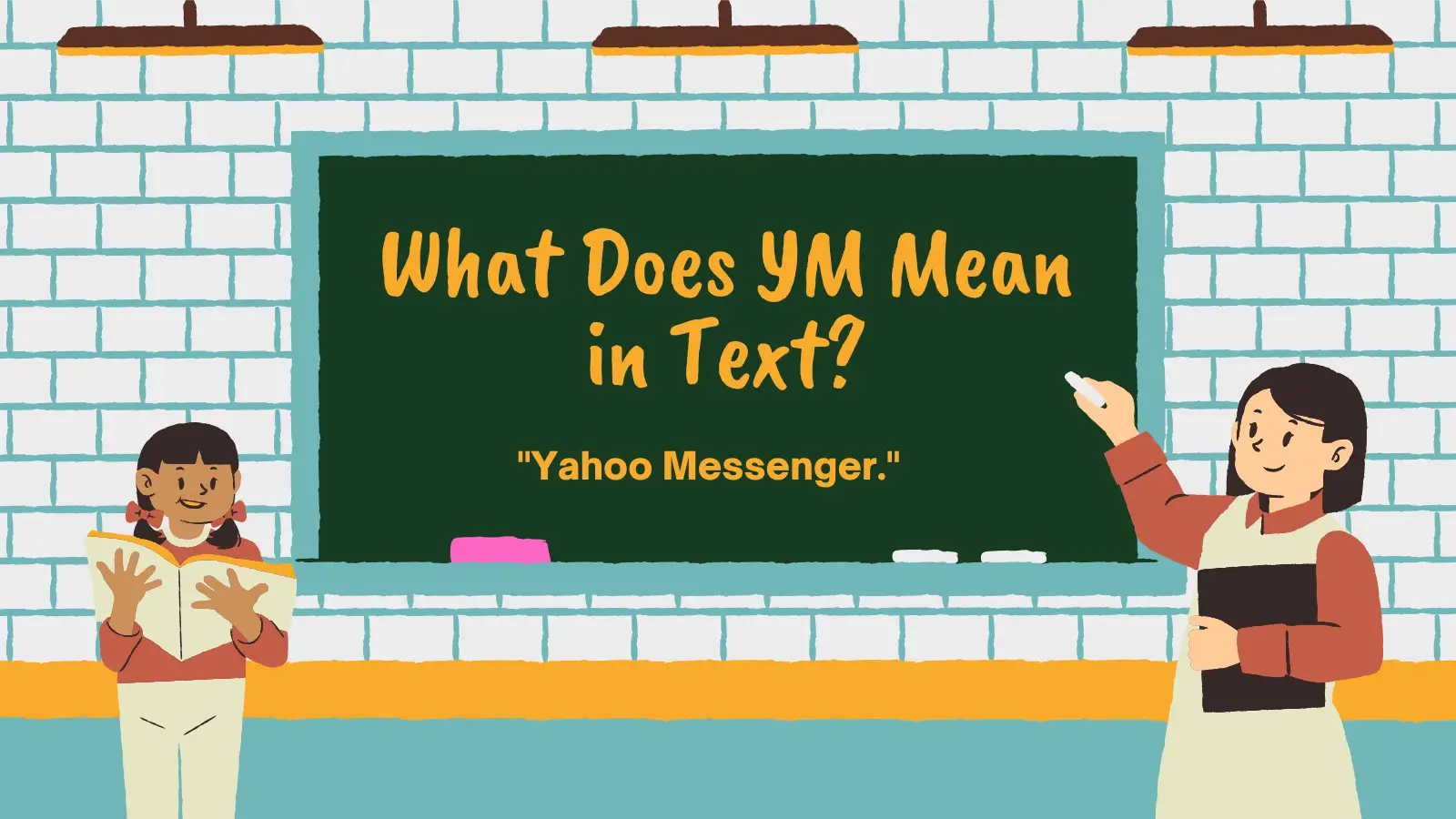
An older but still recognized meaning is “Yahoo Messenger,” referring to the once-popular instant messaging platform from the early 2000s. Though the service has long since shut down, the abbreviation still occasionally appears in nostalgic conversations about early internet chat culture.
Less commonly, this abbreviation can also stand for “Young Man,” typically used in a more formal or old-fashioned tone, or “You’re Mine,” used romantically between partners.
Because the possible meanings range from playful teasing to genuine questions to outdated tech references, context and tone are essential for figuring out which one applies in any given conversation.
Origin of The Word
The “Your Mom” joke format has deep roots in comedy and casual banter, tracing back decades before texting even existed.
As digital communication sped up and users looked for faster ways to deliver familiar jokes, shortening the classic phrase into two letters became a natural evolution, fitting neatly into fast-paced group chats and social media comment threads.
The “You Mean” usage likely developed similarly to other clarification-based texting shorthand, where speakers compress common conversational phrases to keep exchanges quick and efficient, especially in back-and-forth messaging where every extra keystroke adds friction.
The “Yahoo Messenger” meaning, meanwhile, comes from a completely different era of internet history.
Yahoo Messenger was one of the dominant instant messaging platforms in the late 1990s and early 2000s, competing directly with AOL Instant Messenger and MSN Messenger before falling out of use as social media and smartphone messaging apps took over.
Even though the platform itself is gone, its abbreviation lives on in occasional references to that period of online culture.
What makes this term interesting is how differently each meaning developed: one from comedy culture, one from practical texting shorthand, and one from a specific piece of now-defunct software, yet all three continue to share the same two letters without much real-world confusion, since context almost always makes the intended meaning clear.
Usage in Different Contexts (Chat, Social Media, Professional Fields)
In casual texting between friends, this abbreviation is almost always either the joking “Your Mom” comeback or the clarifying “You Mean” question, and tone usually makes the distinction obvious.
A quick, laughing reply after a joke points to the humorous meaning, while a message ending in a question mark points to the clarification meaning.
On social media, particularly in comment sections and group chats among younger users, the joking usage dominates, often paired with laughing emojis or other playful reactions to keep the tone light.
In professional or formal writing, none of the casual meanings apply, and the abbreviation is essentially never used, since it carries no established professional definition.
If it appears at all in a workplace or technical setting, it’s most likely a reference to Young’s Modulus, a legitimate engineering and physics term discussed further below.
Recognizing the setting is key: casual chat points toward joking or clarifying usage, while any technical or scientific document points toward the entirely unrelated physics meaning.
Meaning in Chat, WhatsApp, Instagram, TikTok
- General texting and WhatsApp: Commonly used for both the “Your Mom” joke and the “You Mean” clarification, with tone and surrounding words usually making the intended meaning clear.
- Instagram: Frequently seen in comment sections as a lighthearted joke response, especially among younger users engaging in playful banter.
- TikTok: Used similarly to Instagram, often appearing in comment threads reacting to videos with a quick, humorous jab.
- Snapchat: Also common here in the joking sense, often exchanged quickly between friends as part of ongoing playful conversations.
Across all of these platforms, the joking “Your Mom” meaning tends to be far more visible than the older “Yahoo Messenger” reference, which has become largely nostalgic rather than practical in modern conversations.
Meaning in Physics, Medical, and Aircraft Terminology
Away from casual texting, this abbreviation takes on a much more precise and technical identity in certain specialized fields:
- Physics
- In physics and materials engineering, YM stands for Young’s Modulus, a measurement of a material’s stiffness. It shows how strongly a material resists stretching or compression when force acts on it. Engineers use Young’s Modulus to choose the right materials for construction, manufacturing, and product design because materials with a higher value resist deformation more effectively than those with a lower value.
- Medical Field
- The medical field does not recognize YM as a standard abbreviation. However, healthcare professionals may use the term Young’s Modulus when discussing biomedical implants, prosthetics, and medical devices. They rely on this measurement to evaluate material stiffness and select materials that provide safety, durability, and patient comfort.
- Aviation and Aircraft Terminology
- The aviation industry does not assign a unique standard meaning to YM. Instead, aerospace engineers use Young’s Modulus to evaluate the stiffness of metals and composite materials. They apply this measurement when selecting materials that can withstand stress and maintain the strength and stability of aircraft structures and components.
In short, the technical meaning of this abbreviation is far more consistent than its casual counterparts in scientific and engineering contexts; it almost always points back to the same materials-science concept.
Common Misconceptions
One common misconception is assuming this abbreviation always carries the joking “Your Mom” meaning, regardless of context. In reality, tone and surrounding conversation matter significantly; the same two letters can just as easily be a genuine request for clarification rather than an attempt at humor.
Another misunderstanding involves assuming the “Yahoo Messenger” meaning is still commonly relevant today.
Since the platform shut down years ago, this meaning is now almost entirely nostalgic, appearing mostly in conversations reminiscing about early internet culture rather than in any practical, modern context.
Many people mistakenly believe the joking usage is always mean-spirited. However, most friends use it as harmless, lighthearted teasing rather than a genuine insult, much like other classic joke formats that comedians have enjoyed for generations.
Many people also mistakenly think the technical, physics-related meaning connects to the casual texting definitions. In reality, these meanings belong to completely different contexts and have no relationship with each other.
In reality, the two exist in completely separate worlds, with no meaningful overlap between engineering terminology and everyday slang.
Similar Terms & Alternatives
A handful of related expressions and abbreviations often appear alongside this one, depending on which meaning is intended:
- Yo Mama: The full, spelled-out version of the classic joke format, often used interchangeably with the abbreviated version.
- WYM (“What You Mean”): A close cousin used specifically for clarification, functioning almost identically to the “You Mean” usage.
- AIM (AOL Instant Messenger): A related nostalgic reference from the same early-internet messaging era as Yahoo Messenger.
- E (Young’s Modulus symbol): Frequently used interchangeably with the abbreviation in physics and engineering formulas and diagrams.
- YW (“You’re Welcome”): Visually similar but entirely unrelated in meaning, sometimes mixed up due to the shared first letter.
Each of these alternatives helps narrow down intent, especially in ambiguous conversations where the abbreviation alone might not make the meaning obvious.
How to Respond to It
If a friend sends this abbreviation as a joking comeback after a lighthearted insult, laugh it off or reply with your own playful joke. The abbreviation keeps the conversation fun instead of turning it into a serious discussion.
If someone uses it to ask for clarification, explain or rephrase what you said. Treat the message as a genuine question instead of a joke.
It appears in a nostalgic conversation about early internet culture, referencing the old messaging platform; the natural response is just to continue reminiscing about that era of online communication.
If it shows up in a technical or academic context referring to materials science, the appropriate response depends on the conversation: if that means discussing a specific material’s properties, referencing a formula, or continuing a broader engineering discussion.
Differences from Similar Words
It’s worth separating this abbreviation clearly from a few commonly confused terms. Unlike “YW” (“you’re welcome”), which is a polite response to thanks, this term carries none of that meaning despite the visual similarity in casual scrolling.
It also differs meaningfully from “WYM,” which exists specifically to ask for clarification. While this abbreviation can carry that same clarifying meaning, it isn’t dedicated to it the way “WYM” is, making the two only partial overlaps rather than direct equivalents.
Compared to its technical meaning, the contrast is stark. In casual chat, it’s a flexible, informal term shaped entirely by tone and relationship, while in physics and engineering, it refers to a precise, mathematically defined property with a standardized formula and consistent meaning across the entire field.
Relevance in Online Conversations & Dating Apps
In everyday online conversations, particularly among younger users, the joking usage of this abbreviation plays a small role in maintaining a playful, low-stakes tone between friends, helping keep casual banter light without requiring longer typed-out jokes.
On dating apps, this specific abbreviation is far less common, since the joking format doesn’t translate especially well to early conversations between people who don’t know each other yet.
It’s more likely to appear once two people have built enough rapport to comfortably tease one another, rather than during initial introductions.
In broader online spaces, recognizing the difference between the humorous, clarifying, and nostalgic meanings helps prevent unnecessary confusion; a quick joking reply carries a completely different tone than a genuine request for clarification, even though both rely on identical letters.
Conclusion:
This small, flexible abbreviation carries more range than its two letters might suggest. In casual texting, it’s most often a playful “Your Mom” joke or a quick way of asking “you mean?” for clarification.
In nostalgic conversations, it can reference an old instant messaging platform from the early internet era. And in physics and engineering, it points to an entirely different concept tied to how materials respond to stress.
As with most flexible slang, tone and context ultimately decide which meaning fits, making it easier to read the room and respond appropriately no matter where this term shows up.
Read More Posts:
- Examples of LB in Conversations
- CV Meaning in Jobs and Careers
- How People Use ISH in Daily Conversations (2026)

Toni Morrison is a celebrated American novelist known for her powerful storytelling, rich characters, and lasting impact on literature. At GrammerNests.com, she shares insights that help readers appreciate language, writing, and literary expression.